
A hedge in the dacha with your own hands: the rules for planting, growing and careSo it was said that we are trying to make our own small"world"without restricting ourselves, protecting our earthly lands through the manifestations of the surrounding world - neighbors and curious passers-by, wind and noise, exhaust gases and car rumble. All, not all of us are amused by the future, without stopping, to gaze into the rather small two-meter-high city that delineates the boundaries of our possessions. It seems to fulfill its"kingdom"hard to reach for others, without disturbing the natural beauty of the garden landscape? The objection for this task is hidden in the depths of the 18th century, if for the first time the fence was alive - a thick linear plantation of garden and park plants designed to protect and, at the same time, decorate the personal area.
Close knowledge with a green fence
Greenish protection, located for the boundary of your land plot, is a rather natural barrier of dust, noise and wind, also annoying neighbors and uninvited guests. The fence for a dacha is mostly good, because it does not ask for such significant currency investments, like the construction of a serious fence. An excellent variation for the sake of a summer residence - a freely growing fence - it's quite simple to make it by yourself, because it does not ask for repeated haircuts, like regular hedges of regular geometric shape. Separate attention deserves a fence of roses, which will perfectly decorate the facade of the house, a gazebo or a sad city. Beautifully looked fence of the girlish virginity - it does not need a special upbringing, and in the autumn reddish grape leaves will create a graced atmosphere in the garden. Live fence of grapes can serve and fencing, and a good background for the sake of other parts of landscape design
The future of green fences The hedges have passed a long road of development, before being in our time. Probably therefore, the fence formed with the help of decorative plants, has such a variety of forms and forms. Greenish fence, formed in the form of a low curb - an original frame for the sake of flower beds and paths
Proceeding from this property, a restless hedge, like the vys, is allowed to distinguish three types of this enclosing plantation:
low curbs in front of 1 meter in height - for delineating the boundaries of lawns, flower beds, paths
live fence height of 1-2 meters - for the sake of dividing the site for multifunctional zones
live fence height of 2 meters and more - for the sake of planting along the boundaries of the site
Depending on the intensity of the haircuts, the greenish hedges are divided for molded and loosely growing. As a reward through molded hedges, which are given a precise geometric appearance with the help of a haircut, the freely growing fences are not actually adjusted and grow in a random direction. A freely growing fence of various types of shrubs will decorate the view of the site in a landscape style
Another parameter, according to which the hedges are systematized - the rowing of the landing. Greenish fence, the development of which plants are planted in one line, refers to single-row. Two-and three-row fences imply the division of plants by several lines in the form of multi-level lines. A single-row greenish fence is formed from plants planted for equal distance by a well-wisher through a friend. For shrubs, the steps of planting are almost 30-50 cm, for the sake of trees - through 75 before 150 cm. In a multi-row hedge the plants are planted in a staggered order, this distance between them is respected depending on the expected size of the crown and the elevation.
Multi-row cascading hedges are done with some kind of fantasy, combining freely growing and molded"steps"from different types of bushes and trees. A beautiful blossoming protection is allowed to be made with the help of an unformed hedge of honeysuckle, irgi, barberry and other shrubs. For the sake of planting, hectic hedges of mixed type are consumed by plants of the 1st type, but of different types, possessing a different coloring of foliage or needles. Look good composition violet and greenish scarecrow, greenish and variegated hymen or holly. Such multi-layered fences take up a lot of space, but are more effectively protected through unnecessary looks and intrusions, a gassed atmosphere and highway noise. For the creation of a molded hedge, it is ideal to plant plants with small foliage - they will provide a fenced dense appearance
In the process of cutting, the greenish hedge is likely to give any shape - through the geometric before the rounded
Plant selection for the green fence
To be a plant choice for planting in the form of a hectic hedge, it is better to give importance to those of them who have passed the"check for strength"in Russian weather criteria. It should be winter-resistant, undemanding plants with curdled foliage, which are perfectly restored afterwards haircuts and have the highest ability to form shoots. It is worth to pay homage for such trees, like maple, hornbeam, thorn and bushes - biryučinu, hawthorn, cotoneaster. Beautiful looking hedges of jasmine, sea buckthorn, rhododendron, barberry, honeysuckle, rose wrinkled, lilac, irgi. For the creation of a green hedge pick up plants with small foliage, which are repeatable haircut form a uniform appearance. A dense impenetrable fence is allowed to be made from lilac bushes and rhododendron growing in a free manner
Arrangement of green fence
To choose a planting material for the sake of a restless hedge, must take a closer look at the root system and the crown of plants - the roots should not exist overdried, the crown - uniform according to its own form. For the sake of planting a plantation in the form of a fence, select young bushes and trees 3 years before 6 years old, which are fairly developed and capable of easily settling in the new criteria.
Before the formation of green fencing should learn, it seems to be correct to plant a live fence, so that plants do not experience shortages in the sun, moisture and nutrient substances. In this connection, the principal point is the choice of the site for the planting of the fence and the season for the transfer of plants to the open land. Usually, a hectic hedge is made in the spring, then, as the bottom has dried up, or in the fall, if winter hardy plants are chosen for the formation of live fencing. The room for the location of the green fence is selected far from the buildings - for a distance of more than 2 meters and in 0.5-1.5 meters through a serious fence. To be planted, a restless hedge must dig a trench, loosen and fertilize its bottom, arrange a seedling and compact the earth.
Before the planting starts, the hedge must map the line of its location with a stretched cord. Along the lane markings dig a trench with a depth of 0.5 meters. The width of the trench depends on the sequence of the greenish hedge-for single-row hedges it is 40-50 cm, for the sake of multi-row - plus 50 cm for each next row. The density of planting the fence is affected by the characteristics of certain plants, the expected height and the number of rows of live fencing. Heavy hedges are used to create secluded places for recreation -"green rooms"
Density of planting seedlings for 1 meter of fence:
small shrub (mahonia, spiraea) 5-7 bushes
finger bush (snow leopard, cotoneaster) 4-5 bushes
The tallest (2-3 m) trees and bushes (vesicle, hawthorn) 1-2 plants
Planting a hedge of coniferous plants The pit is dug by a diameter that is 2 times the size of the rhizome. The garden land, taken out to dig a pit, is combined with compost, organic fertilizer and silica, then the bottom of the pit is sprinkled with it. Coniferous plant species are in most cases sold in plastic containers. Before planting, the cautious plant is taken out of the container and planted in an open land with an intact land clod. Then, like a tree is installed in a planting pit, it is covered with earth, which is then compacted, but not rammed. For some distance, through the landing strip, an irrigated top is formed in the form of a low hill, preventing the water from spreading. According to the end of planting works, plants are watered a lot. The fence alive, pleasing the eye with its own green curve of the year, can exist formed from evergreen conifers
Planting hedges from deciduous plants
Deciduous medium-tall or tall shrubs and trees are sold, preferably with a bare root system, which is pre-planted for several hours and cut, removing the warped and longish processes. The pit is prepared for planting in order to plant the plant for a depth not exceeding that for which it was planted earlier. The earth taken out of the pit is mixed with organic fertilizers, compost and partly returned to the bottom of the pit. A bush or a tree is placed in a pit and sprinkled with the remaining soil, keeping track of the density of the fill - so that between the roots of the plant there is no emptiness. If the tree has the highest trunk, a supporting tree is slaughtered to the bottom of the pit, for a depth of 50 cm, to which the tree is tied firmly to the end of the landing. A freely growing fence is often formed from a variety of deciduous trees and shrubs
Planting a hedge from a bush
Low bush seedlings are usually grown in plastic containers, which provide the root system of the plant with reliable protection. This allows you not to adhere to the exact timing of planting bushes in open land. Deepening near the planting of the bush is prepared taking into account the size of the rhizome of the plant and the ground coma. To be planted, the plant is released through a container with the preservation of the ground coma and placed in a dug hole. Then filling the emptiness of the landing pit with earth, a high discharge of soil is compacted and watered a little. Live fence in the form of a freestanding curb from a low bush unobtrusively delineate the boundary of a greenish lawn or glades
For the planting of a large shrub you need to get a trench about 1 m wide and 50-60 cm deep. The bottom of the trench is loosened with pitchforks for a depth of 20 cm and connect the loosened discharge of the earth with peat, sheet humus, manure or compost. It is good to add lime, wood ash and a little phosphate fertilizer. Lavender lobes, planted in the form of a rounded curb, beautifully accentuated the path led to the house
Planting a trellis
Quite often, if a fence for a dacha is being formed, the thriftiness of the place of a small garden plot is placed at the forefront. It seems to be allowed to bring up a living fence in the cramped conditions of an earth plot, limited to 6 hundred parts? In order to make a greenish fence in the form of a curd, but not a wide row, the plants are planted for a short distance by a well-wisher through a friend - about 20 cm. The trellis fence looks great if it is formed from such plants, like a yellowish acacia, a willow, a mountain ash or a hawthorn . Narrow and, at the same time, a dense live hedge-trellis is allowed to collect from ordinary windmills
Through the year, the planted trees and bushes are pruned, as they say,"to the stump"- leaving 10-15 cm of the aboveground part of the plant. Again, a year later, in the spring, they carry out a serious pruning of the fence, keeping fairly strong shoots, which are interlaced alternately by a angle of 45 degrees, cutting off the bark in the places where the branches are in contact. The acquired diamond-shaped"pattern"is fixed to the frame in the form of a mesh structure constructed for the base of stakes driven with a small step into the ground and cross-members. The trellis fence is grown by the way of a cross-shaped interlacing of shoots of shrubs or low trees
After, all the side shoots, the row is cut 2-3 times because of the season, adhering to the vertical plane, which provokes the upcoming branching of the fence upwards. The constant lateral shearing of the trellis hectic hedge is oriented for the product of its uniform width - about 30 cm. The trellis is also sheared from above, maintaining a certain height of the green fence. The same ignoramus of the city can be resurrected with the help of a flashy lot of"flowering trellis"of wicker roses
Parenting because of the greenish hedge
Putting green protection for a personal or dacha site, it should be borne in mind that the upbringing during the season due to a hectic hedge is much more difficult than that due to ordinary garden plants. This is due more to the fact that due to the plant hedge must be constantly taken care of - watering, fertilizing and extracting. If we concern ourselves with the issue of trimming and cutting a hedge without attention - it can grow without reason, which is quite unrealistic to bring it into the schedule and you will have to answer the landing"to zero." The luxuriant inflorescences of hydrangeas collected in a living fence will beautify your park with a catchy accent and will be fenced through uninvited guests
Cutting rules and balance
Pruning to be planted
Deciduous varieties of trees and shrubs, formed into a living fence, are cut off at the outset after planting, leaving 10-15 cm of the above-ground part of the seedlings in order to accelerate the gain of shoots at the base. If the seedlings were purchased with a bare root system, then pruning of the above-ground part should be done in half of the existing elevation. Saplings grown in a container trim for one-third of the hill. The combination of multi-high and multi-colored curbs of a geometric shape will give your garden a unique spectrum
Pruning in the 2nd season
Through the year, a planted live fence is cut near 4 once a season from May to August. Light trimming for the second year of the fence's existence is oriented for giving the planting a certain shape and increasing the density of branching.
In a strong pruning - for a height of about 15 cm through the surface of the soil, such future bushes need: cob, hawthorn, thorn, tamarix. On 1/3 the height of new shoots is cut: cotoneaster, hornbeam, barberry, boxwood, beech. The cardinal remnant does not require: juniper, laurel, cypress, cypress. In such hedges, only a few twigs are cut, which are knocked out of the general mass and assign dirty visibility to the fence.
Close knowledge with a green fence
Greenish protection, located for the boundary of your land plot, is a rather natural barrier of dust, noise and wind, also annoying neighbors and uninvited guests. The fence for a dacha is mostly good, because it does not ask for such significant currency investments, like the construction of a serious fence. An excellent variation for the sake of a summer residence - a freely growing fence - it's quite simple to make it by yourself, because it does not ask for repeated haircuts, like regular hedges of regular geometric shape. Separate attention deserves a fence of roses, which will perfectly decorate the facade of the house, a gazebo or a sad city. Beautifully looked fence of the girlish virginity - it does not need a special upbringing, and in the autumn reddish grape leaves will create a graced atmosphere in the garden. Live fence of grapes can serve and fencing, and a good background for the sake of other parts of landscape design
The future of green fences The hedges have passed a long road of development, before being in our time. Probably therefore, the fence formed with the help of decorative plants, has such a variety of forms and forms. Greenish fence, formed in the form of a low curb - an original frame for the sake of flower beds and paths
Proceeding from this property, a restless hedge, like the vys, is allowed to distinguish three types of this enclosing plantation:
low curbs in front of 1 meter in height - for delineating the boundaries of lawns, flower beds, paths
live fence height of 1-2 meters - for the sake of dividing the site for multifunctional zones
live fence height of 2 meters and more - for the sake of planting along the boundaries of the site
Depending on the intensity of the haircuts, the greenish hedges are divided for molded and loosely growing. As a reward through molded hedges, which are given a precise geometric appearance with the help of a haircut, the freely growing fences are not actually adjusted and grow in a random direction. A freely growing fence of various types of shrubs will decorate the view of the site in a landscape style
Another parameter, according to which the hedges are systematized - the rowing of the landing. Greenish fence, the development of which plants are planted in one line, refers to single-row. Two-and three-row fences imply the division of plants by several lines in the form of multi-level lines. A single-row greenish fence is formed from plants planted for equal distance by a well-wisher through a friend. For shrubs, the steps of planting are almost 30-50 cm, for the sake of trees - through 75 before 150 cm. In a multi-row hedge the plants are planted in a staggered order, this distance between them is respected depending on the expected size of the crown and the elevation.
Multi-row cascading hedges are done with some kind of fantasy, combining freely growing and molded"steps"from different types of bushes and trees. A beautiful blossoming protection is allowed to be made with the help of an unformed hedge of honeysuckle, irgi, barberry and other shrubs. For the sake of planting, hectic hedges of mixed type are consumed by plants of the 1st type, but of different types, possessing a different coloring of foliage or needles. Look good composition violet and greenish scarecrow, greenish and variegated hymen or holly. Such multi-layered fences take up a lot of space, but are more effectively protected through unnecessary looks and intrusions, a gassed atmosphere and highway noise. For the creation of a molded hedge, it is ideal to plant plants with small foliage - they will provide a fenced dense appearance
In the process of cutting, the greenish hedge is likely to give any shape - through the geometric before the rounded
Plant selection for the green fence
To be a plant choice for planting in the form of a hectic hedge, it is better to give importance to those of them who have passed the"check for strength"in Russian weather criteria. It should be winter-resistant, undemanding plants with curdled foliage, which are perfectly restored afterwards haircuts and have the highest ability to form shoots. It is worth to pay homage for such trees, like maple, hornbeam, thorn and bushes - biryučinu, hawthorn, cotoneaster. Beautiful looking hedges of jasmine, sea buckthorn, rhododendron, barberry, honeysuckle, rose wrinkled, lilac, irgi. For the creation of a green hedge pick up plants with small foliage, which are repeatable haircut form a uniform appearance. A dense impenetrable fence is allowed to be made from lilac bushes and rhododendron growing in a free manner
Arrangement of green fence
To choose a planting material for the sake of a restless hedge, must take a closer look at the root system and the crown of plants - the roots should not exist overdried, the crown - uniform according to its own form. For the sake of planting a plantation in the form of a fence, select young bushes and trees 3 years before 6 years old, which are fairly developed and capable of easily settling in the new criteria.
Before the formation of green fencing should learn, it seems to be correct to plant a live fence, so that plants do not experience shortages in the sun, moisture and nutrient substances. In this connection, the principal point is the choice of the site for the planting of the fence and the season for the transfer of plants to the open land. Usually, a hectic hedge is made in the spring, then, as the bottom has dried up, or in the fall, if winter hardy plants are chosen for the formation of live fencing. The room for the location of the green fence is selected far from the buildings - for a distance of more than 2 meters and in 0.5-1.5 meters through a serious fence. To be planted, a restless hedge must dig a trench, loosen and fertilize its bottom, arrange a seedling and compact the earth.
Before the planting starts, the hedge must map the line of its location with a stretched cord. Along the lane markings dig a trench with a depth of 0.5 meters. The width of the trench depends on the sequence of the greenish hedge-for single-row hedges it is 40-50 cm, for the sake of multi-row - plus 50 cm for each next row. The density of planting the fence is affected by the characteristics of certain plants, the expected height and the number of rows of live fencing. Heavy hedges are used to create secluded places for recreation -"green rooms"
Density of planting seedlings for 1 meter of fence:
small shrub (mahonia, spiraea) 5-7 bushes
finger bush (snow leopard, cotoneaster) 4-5 bushes
The tallest (2-3 m) trees and bushes (vesicle, hawthorn) 1-2 plants
Planting a hedge of coniferous plants The pit is dug by a diameter that is 2 times the size of the rhizome. The garden land, taken out to dig a pit, is combined with compost, organic fertilizer and silica, then the bottom of the pit is sprinkled with it. Coniferous plant species are in most cases sold in plastic containers. Before planting, the cautious plant is taken out of the container and planted in an open land with an intact land clod. Then, like a tree is installed in a planting pit, it is covered with earth, which is then compacted, but not rammed. For some distance, through the landing strip, an irrigated top is formed in the form of a low hill, preventing the water from spreading. According to the end of planting works, plants are watered a lot. The fence alive, pleasing the eye with its own green curve of the year, can exist formed from evergreen conifers
Planting hedges from deciduous plants
Deciduous medium-tall or tall shrubs and trees are sold, preferably with a bare root system, which is pre-planted for several hours and cut, removing the warped and longish processes. The pit is prepared for planting in order to plant the plant for a depth not exceeding that for which it was planted earlier. The earth taken out of the pit is mixed with organic fertilizers, compost and partly returned to the bottom of the pit. A bush or a tree is placed in a pit and sprinkled with the remaining soil, keeping track of the density of the fill - so that between the roots of the plant there is no emptiness. If the tree has the highest trunk, a supporting tree is slaughtered to the bottom of the pit, for a depth of 50 cm, to which the tree is tied firmly to the end of the landing. A freely growing fence is often formed from a variety of deciduous trees and shrubs
Planting a hedge from a bush
Low bush seedlings are usually grown in plastic containers, which provide the root system of the plant with reliable protection. This allows you not to adhere to the exact timing of planting bushes in open land. Deepening near the planting of the bush is prepared taking into account the size of the rhizome of the plant and the ground coma. To be planted, the plant is released through a container with the preservation of the ground coma and placed in a dug hole. Then filling the emptiness of the landing pit with earth, a high discharge of soil is compacted and watered a little. Live fence in the form of a freestanding curb from a low bush unobtrusively delineate the boundary of a greenish lawn or glades
For the planting of a large shrub you need to get a trench about 1 m wide and 50-60 cm deep. The bottom of the trench is loosened with pitchforks for a depth of 20 cm and connect the loosened discharge of the earth with peat, sheet humus, manure or compost. It is good to add lime, wood ash and a little phosphate fertilizer. Lavender lobes, planted in the form of a rounded curb, beautifully accentuated the path led to the house
Planting a trellis
Quite often, if a fence for a dacha is being formed, the thriftiness of the place of a small garden plot is placed at the forefront. It seems to be allowed to bring up a living fence in the cramped conditions of an earth plot, limited to 6 hundred parts? In order to make a greenish fence in the form of a curd, but not a wide row, the plants are planted for a short distance by a well-wisher through a friend - about 20 cm. The trellis fence looks great if it is formed from such plants, like a yellowish acacia, a willow, a mountain ash or a hawthorn . Narrow and, at the same time, a dense live hedge-trellis is allowed to collect from ordinary windmills
Through the year, the planted trees and bushes are pruned, as they say,"to the stump"- leaving 10-15 cm of the aboveground part of the plant. Again, a year later, in the spring, they carry out a serious pruning of the fence, keeping fairly strong shoots, which are interlaced alternately by a angle of 45 degrees, cutting off the bark in the places where the branches are in contact. The acquired diamond-shaped"pattern"is fixed to the frame in the form of a mesh structure constructed for the base of stakes driven with a small step into the ground and cross-members. The trellis fence is grown by the way of a cross-shaped interlacing of shoots of shrubs or low trees
After, all the side shoots, the row is cut 2-3 times because of the season, adhering to the vertical plane, which provokes the upcoming branching of the fence upwards. The constant lateral shearing of the trellis hectic hedge is oriented for the product of its uniform width - about 30 cm. The trellis is also sheared from above, maintaining a certain height of the green fence. The same ignoramus of the city can be resurrected with the help of a flashy lot of"flowering trellis"of wicker roses
Parenting because of the greenish hedge
Putting green protection for a personal or dacha site, it should be borne in mind that the upbringing during the season due to a hectic hedge is much more difficult than that due to ordinary garden plants. This is due more to the fact that due to the plant hedge must be constantly taken care of - watering, fertilizing and extracting. If we concern ourselves with the issue of trimming and cutting a hedge without attention - it can grow without reason, which is quite unrealistic to bring it into the schedule and you will have to answer the landing"to zero." The luxuriant inflorescences of hydrangeas collected in a living fence will beautify your park with a catchy accent and will be fenced through uninvited guests
Cutting rules and balance
Pruning to be planted
Deciduous varieties of trees and shrubs, formed into a living fence, are cut off at the outset after planting, leaving 10-15 cm of the above-ground part of the seedlings in order to accelerate the gain of shoots at the base. If the seedlings were purchased with a bare root system, then pruning of the above-ground part should be done in half of the existing elevation. Saplings grown in a container trim for one-third of the hill. The combination of multi-high and multi-colored curbs of a geometric shape will give your garden a unique spectrum
Pruning in the 2nd season
Through the year, a planted live fence is cut near 4 once a season from May to August. Light trimming for the second year of the fence's existence is oriented for giving the planting a certain shape and increasing the density of branching.
In a strong pruning - for a height of about 15 cm through the surface of the soil, such future bushes need: cob, hawthorn, thorn, tamarix. On 1/3 the height of new shoots is cut: cotoneaster, hornbeam, barberry, boxwood, beech. The cardinal remnant does not require: juniper, laurel, cypress, cypress. In such hedges, only a few twigs are cut, which are knocked out of the general mass and assign dirty visibility to the fence.
wp-content/uploads/2013/12/J_izgorod_obrezka.jpg"rel="lightbox[3201]"title="Обрезка беспокойный изгороди">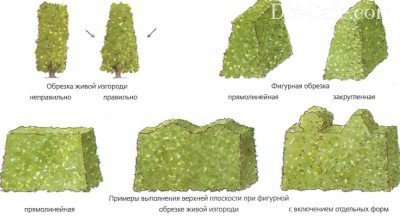
Обрезка беспокойный изгороди производится таким макаром, дабы ее нижняя доля была более широкой. чем верхняяStrike through 2-3 ears
The hedge trimmed hedges in the following years are made for the sake of giving the decorative fence a cautious appearance - lateral branching is cut off, the upper shoots are little aligned. Deciduous trees and bushes trimmed in the early spring - again before the emergence of young leaves, coniferous evergreens can be removed later in the spring or the beginning of the sun. Proudly light! The base of a greenish hedge is formed little wider than the top, so that the lower branches are adequately illuminated and, as appropriate, developed. For the purpose of cutting the long, molded hedges, a special electric tool is used. The top trimming of hectic hedges is done for a height of 10 cm, pre-pulling the latch for the landmark
Live fence of evergreen or small-leaved plants is sheared by electronic implements or scissors. For the sake of the remainder and trimming of large-leafed hedges use secateurs. To be pruned and trimmed, a hectic hedge is allowed to give every form, even the most intricate
Watering and feeding
During the season, the live fence should be accurately watered, before loosening the soil for 50-70 cm on both sides through the planting. Be watered with a stream of water directly to the base of the plants, providing soil moistening for a depth of 30-40 cm. With the help of a low rounded hedge, form a labyrinth in the garden - a place for children's games and secluded rest
Having planted weaving plants at the walls of your house and having arranged a light frame, you will become the owner of a work of park art
In addition to watering, the green fence should be fed with organic and mineral fertilizers. Organic fertilizers - compost, deciduous humus, peat are introduced into the dug up soil in early spring or autumn in quantities of 2 before 5 kg for a single square meter of land. Mineral fertilizers - nitrogen and phosphate-potash are added to the soil depending on the season: nitrogen only in the early spring, phosphate - preferably at the end of the age and early autumn. Autumn bait can be made from such components: 30-40 g of potassium salt, 50-70 g of superphosphate, 50-70 g of ammonium sulfate. small shrub (mahonia, spiraea) 5-7 bushes
finger bush (snow leopard, cotoneaster) 4-5 bushes
The tallest (2-3 m) trees and bushes (vesicle, hawthorn) 1-2 plants
Planting a hedge of coniferous plants The pit is dug by a diameter that is 2 times the size of the rhizome. The garden land, taken out to dig a pit, is combined with compost, organic fertilizer and silica, then the bottom of the pit is sprinkled with it. Coniferous plant species are in most cases sold in plastic containers. Before planting, the cautious plant is taken out of the container and planted in an open land with an intact land clod. Then, like a tree is installed in a planting pit, it is covered with earth, which is then compacted, but not rammed. For some distance, through the landing strip, an irrigated top is formed in the form of a low hill, preventing the water from spreading. According to the end of planting works, plants are watered a lot. The fence alive, pleasing the eye with its own green curve of the year, can exist formed from evergreen conifers
Planting hedges from deciduous plants
Deciduous medium-tall or tall shrubs and trees are sold, preferably with a bare root system, which is pre-planted for several hours and cut, removing the warped and longish processes. The pit is prepared for planting in order to plant the plant for a depth not exceeding that for which it was planted earlier. The earth taken out of the pit is mixed with organic fertilizers, compost and partly returned to the bottom of the pit. A bush or a tree is placed in a pit and sprinkled with the remaining soil, keeping track of the density of the fill - so that between the roots of the plant there is no emptiness. If the tree has the highest trunk, a supporting tree is slaughtered to the bottom of the pit, for a depth of 50 cm, to which the tree is tied firmly to the end of the landing. A freely growing fence is often formed from a variety of deciduous trees and shrubs
Planting a hedge from a bush
Low bush seedlings are usually grown in plastic containers, which provide the root system of the plant with reliable protection. This allows you not to adhere to the exact timing of planting bushes in open land. Deepening near the planting of the bush is prepared taking into account the size of the rhizome of the plant and the ground coma. To be planted, the plant is released through a container with the preservation of the ground coma and placed in a dug hole. Then filling the emptiness of the landing pit with earth, a high discharge of soil is compacted and watered a little. Live fence in the form of a freestanding curb from low bush unobtrusively delineate the boundary of a greenish lawn or glades
For the planting of a large shrub you need to get a trench about 1 m wide and 50-60 cm deep. The bottom of the trench is loosened with pitchforks for a depth of 20 cm and connect the loosened discharge of the earth with peat, sheet humus, manure or compost. It is good to add lime, wood ash and a little phosphate fertilizer. Lavender lobes, planted in the form of a rounded curb, beautifully accentuated the path led to the house
Planting a trellis
Quite often, if a fence for a dacha is being formed, the thriftiness of the place of a small garden plot is placed at the forefront. It seems to be allowed to bring up a living fence in the cramped conditions of an earth plot, limited to 6 hundred parts? In order to make a greenish fence in the form of a curd, but not a wide row, the plants are planted for a short distance by a well-wisher through a friend - about 20 cm. The trellis fence looks great if it is formed from such plants, like a yellowish acacia, a willow, a mountain ash or a hawthorn . Narrow and, at the same time, a dense live hedge-trellis is allowed to collect from ordinary windmills
Through the year, the planted trees and bushes are pruned, as they say,"to the stump"- leaving 10-15 cm of the aboveground part of the plant. Again, a year later, in the spring, they carry out a serious pruning of the fence, keeping fairly strong shoots, which are interlaced alternately by a angle of 45 degrees, cutting off the bark in the places where the branches are in contact. The acquired diamond-shaped"pattern"is fixed to the frame in the form of a mesh structure constructed for the base of stakes driven with a small step into the ground and cross-members. The trellis fence is grown by the way of a cross-shaped interlacing of shoots of shrubs or low trees
After, all the side shoots, the row is cut 2-3 times because of the season, adhering to the vertical plane, which provokes the upcoming branching of the fence upwards. The constant lateral shearing of the trellis hectic hedge is oriented for the product of its uniform width - about 30 cm. The trellis is also sheared from above, maintaining a certain height of the green fence. The same ignoramus of the city can be resurrected with the help of a riveting lot of"flowering trellis"of wicker roses
Parenting because of the greenish hedge
Putting green protection for a personal or dacha site, it should be borne in mind that the upbringing during the season due to a hectic hedge is much more difficult than that due to ordinary garden plants. This is due more to the fact that due to the plant hedge must be constantly taken care of - watering, fertilizing and extracting. If we concern ourselves with the issue of trimming and cutting a hedge without attention - it can grow without reason, which is quite unrealistic to bring it into the schedule and it will be necessary to answer the landing"to zero." The luxuriant inflorescences of hydrangeas collected in a living fence will beautify your park with a catchy accent and will be fenced through uninvited guests
Cutting rules and balance
Pruning to be planted
Deciduous varieties of trees and shrubs, formed into a living fence, are cut off at the outset after planting, leaving 10-15 cm of the above-ground part of the seedlings in order to accelerate the gain of shoots at the base. If the seedlings were purchased with a bare root system, then pruning of the above-ground part should be done in half of the existing elevation. Saplings grown in a container trim for one-third of the hill. The combination of multi-high and multi-colored curbs of a geometric shape will give your garden a unique spectrum
Pruning in the 2nd season
Through the year, a planted live fence is cut near 4 once a season from May to August. Light trimming for the second year of the fence's existence is oriented for giving the planting a certain shape and increasing the density of branching.
In a strong pruning - for a height of about 15 cm through the surface of the soil, such future bushes need: cob, hawthorn, thorn, tamarix. On 1/3 the height of new shoots is cut: cotoneaster, hornbeam, barberry, boxwood, beech. The cardinal remnant does not require: juniper, laurel, cypress, cypress. In such hedges, only a few twigs are cut, which are knocked out of the general mass and assign dirty visibility to the fence.
Обрезка беспокойный изгороди производится таким макаром, дабы ее нижняя доля была более широкой. чем верхняяStrike through 2-3 ears
The hedge trimmed hedges in the following years are made for the sake of giving the decorative fence a cautious appearance - lateral branching is cut off, the upper shoots are little aligned. Deciduous trees and bushes trimmed in the early spring - again before the emergence of young leaves, coniferous evergreens can be removed later in the spring or the beginning of the sun. Proudly light! The base of a greenish hedge is formed little wider than the top, so that the lower branches are adequately illuminated and, as appropriate, developed. For the purpose of cutting the long, molded hedges, a special electric tool is used. The top trimming of hectic hedges is done for a height of 10 cm, pre-pulling the latch for the landmark
Live fence of evergreen or small-leaved plants is sheared by electronic implements or scissors. For the sake of the remainder and trimming of large-leafed hedges use secateurs. To be pruned and trimmed, a hectic hedge is allowed to give every form, even the most intricate
Watering and feeding
During the season, the live fence should be accurately watered, before loosening the soil for 50-70 cm on both sides through the planting. Be watered with a stream of water directly to the base of the plants, providing soil moistening for a depth of 30-40 cm. With the help of a low rounded hedge, form a labyrinth in the garden - a place for children's games and secluded rest
Having planted weaving plants at the walls of your house and having arranged a light frame, you will become the owner of a work of park art
In addition to watering, the green fence should be fed with organic and mineral fertilizers. Organic fertilizers - compost, deciduous humus, peat are introduced into the dug up soil in early spring or autumn in quantities of 2 before 5 kg for a single square meter of land. Mineral fertilizers - nitrogen and phosphate-potash are added to the soil depending on the season: nitrogen only in the early spring, phosphate - preferably at the end of the age and early autumn. Autumn bait can be made from such components: 30-40 g of potassium salt, 50-70 g of superphosphate, 50-70 g of ammonium sulfate. small shrub (mahonia, spiraea) 5-7 bushes
finger bush (snow leopard, cotoneaster) 4-5 bushes
The tallest (2-3 m) trees and bushes (vesicle, hawthorn) 1-2 plants
Planting a hedge of coniferous plants The pit is dug by a diameter that is 2 times the size of the rhizome. The garden land, taken out to dig a pit, is combined with compost, organic fertilizer and silica, then the bottom of the pit is sprinkled with it. Coniferous plant species are in most cases sold in plastic containers. Before planting, the cautious plant is taken out of the container and planted in an open land with an intact land clod. Then, like a tree is installed in a planting pit, it is covered with earth, which is then compacted, but not rammed. For some distance, through the landing strip, an irrigated top is formed in the form of a low hill, preventing the water from spreading. According to the end of planting works, plants are watered a lot. The fence alive, pleasing the eye with its own green curve of the year, can exist formed from evergreen conifers
Planting hedges from deciduous plants
Deciduous medium-tall or tall shrubs and trees are sold, preferably with a bare root system, which is pre-planted for several hours and cut, removing the warped and longish processes. The pit is prepared for planting in order to plant the plant for a depth not exceeding that for which it was planted earlier. The earth taken out of the pit is mixed with organic fertilizers, compost and partly returned to the bottom of the pit. A bush or a tree is placed in a pit and sprinkled with the remaining soil, keeping track of the density of the fill - so that between the roots of the plant there is no emptiness. If the tree has the highest trunk, a supporting tree is slaughtered to the bottom of the pit, for a depth of 50 cm, to which the tree is tied firmly to the end of the landing. A freely growing fence is often formed from a variety of deciduous trees and shrubs
Planting a hedge from a bush
Low bush seedlings are usually grown in plastic containers, which provide the root system of the plant with reliable protection. This allows you not to adhere to the exact timing of planting bushes in open land. Deepening near the planting of the bush is prepared taking into account the size of the rhizome of the plant and the ground coma. To be planted, the plant is released through a container with the preservation of the ground coma and placed in a dug hole. Then filling the emptiness of the landing pit with earth, a high discharge of soil is compacted and watered a little. Live fence in the form of a freestanding curb from low bush unobtrusively delineate the boundary of a greenish lawn or glades
For the planting of a large shrub you need to get a trench about 1 m wide and 50-60 cm deep. The bottom of the trench is loosened with pitchforks for a depth of 20 cm and connect the loosened discharge of the earth with peat, sheet humus, manure or compost. It is good to add lime, wood ash and a little phosphate fertilizer. Lavender lobes, planted in the form of a rounded curb, beautifully accentuated the path led to the house
Planting a trellis
Quite often, if a fence for a dacha is being formed, the thriftiness of the place of a small garden plot is placed at the forefront. It seems to be allowed to bring up a living fence in the cramped conditions of an earth plot, limited to 6 hundred parts? In order to make a greenish fence in the form of a curd, but not a wide row, the plants are planted for a short distance by a well-wisher through a friend - about 20 cm. The trellis fence looks great if it is formed from such plants, like a yellowish acacia, a willow, a mountain ash or a hawthorn . Narrow and, at the same time, a dense live hedge-trellis is allowed to collect from ordinary windmills
Through the year, the planted trees and bushes are pruned, as they say,"to the stump"- leaving 10-15 cm of the aboveground part of the plant. Again, a year later, in the spring, they carry out a serious pruning of the fence, keeping fairly strong shoots, which are interlaced alternately by a angle of 45 degrees, cutting off the bark in the places where the branches are in contact. The acquired diamond-shaped"pattern"is fixed to the frame in the form of a mesh structure constructed for the base of stakes driven with a small step into the ground and cross-members. The trellis fence is grown by the way of a cross-shaped interlacing of shoots of shrubs or low trees
After, all the side shoots, the row is cut 2-3 times because of the season, adhering to the vertical plane, which provokes the upcoming branching of the fence upwards. The constant lateral shearing of the trellis hectic hedge is oriented for the product of its uniform width - about 30 cm. The trellis is also sheared from above, maintaining a certain height of the green fence. The same ignoramus of the city can be resurrected with the help of a riveting lot of"flowering trellis"of wicker roses
Parenting because of the greenish hedge
Putting green protection for a personal or dacha site, it should be borne in mind that the upbringing during the season due to a hectic hedge is much more difficult than that due to ordinary garden plants. This is due more to the fact that due to the plant hedge must be constantly taken care of - watering, fertilizing and extracting. If we concern ourselves with the issue of trimming and cutting a hedge without attention - it can grow without reason, which is quite unrealistic to bring it into the schedule and it will be necessary to answer the landing"to zero." The luxuriant inflorescences of hydrangeas collected in a living fence will beautify your park with a catchy accent and will be fenced through uninvited guests
Cutting rules and balance
Pruning to be planted
Deciduous varieties of trees and shrubs, formed into a living fence, are cut off at the outset after planting, leaving 10-15 cm of the above-ground part of the seedlings in order to accelerate the gain of shoots at the base. If the seedlings were purchased with a bare root system, then pruning of the above-ground part should be done in half of the existing elevation. Saplings grown in a container trim for one-third of the hill. The combination of multi-high and multi-colored curbs of a geometric shape will give your garden a unique spectrum
Pruning in the 2nd season
Through the year, a planted live fence is cut near 4 once a season from May to August. Light trimming for the second year of the fence's existence is oriented for giving the planting a certain shape and increasing the density of branching.
In a strong pruning - for a height of about 15 cm through the surface of the soil, such future bushes need: cob, hawthorn, thorn, tamarix. On 1/3 the height of new shoots is cut: cotoneaster, hornbeam, barberry, boxwood, beech. The cardinal remnant does not require: juniper, laurel, cypress, cypress. In such hedges, only a few twigs are cut, which are knocked out of the general mass and assign dirty visibility to the fence.
wp-content/uploads/2013/12/J_izgorod_obrezka.jpg"rel="lightbox [3201]"title="Trimming a hectic hedge">
The hedge trim is done in such a way that its lower part is wider. than the top
Cutting through 2-3 age
The hedge trimmed hedges in the following years are made for the sake of giving the decorative fence a cautious appearance - lateral branching is cut off, the upper shoots are little aligned. Deciduous trees and bushes trimmed in the early spring - again before the emergence of young leaves, coniferous evergreens can be removed later in the spring or the beginning of the sun. Proudly light! The base of a greenish hedge is formed little wider than the top, so that the lower branches are adequately illuminated and, as appropriate, developed. For the purpose of cutting the long, molded hedges, a special electric tool is used. The top trimming of hectic hedges is done for a height of 10 cm, pre-pulling the latch for the landmark
Live fence of evergreen or small-leaved plants is sheared by electronic implements or scissors. For the sake of the remainder and trimming of large-leafed hedges use secateurs. To be pruned and trimmed, a hectic hedge is allowed to give every form, even the most intricate
Watering and feeding
During the season, the live fence should be accurately watered, before loosening the soil for 50-70 cm on both sides through the planting. Be watered with a stream of water directly to the base of the plants, providing soil moistening for a depth of 30-40 cm. With the help of a low rounded hectic hedge, form a labyrinth in the garden - a place for children's games and secluded rest
Having planted weaving plants at the walls of your house and having arranged a light frame, you will become the owner of a work of park art
In addition to watering, the green fence should be fed with organic and mineral fertilizers. Organic fertilizers - compost, deciduous humus, peat are introduced into the dug up soil in early spring or autumn in quantities of 2 before 5 kg for a single square meter of land. Mineral fertilizers - nitrogen and phosphate-potash are added to the soil depending on the season: nitrogen only in the early spring, phosphate - preferably at the end of the age and early autumn. Autumn bait can be made from such components: 30-40 g of potassium salt, 50-70 g of superphosphate, 50-70 g of ammonium sulfate.
Read More »
The hedge trim is done in such a way that its lower part is wider. than the top
Cutting through 2-3 age
The hedge trimmed hedges in the following years are made for the sake of giving the decorative fence a cautious appearance - lateral branching is cut off, the upper shoots are little aligned. Deciduous trees and bushes trimmed in the early spring - again before the emergence of young leaves, coniferous evergreens can be removed later in the spring or the beginning of the sun. Proudly light! The base of a greenish hedge is formed little wider than the top, so that the lower branches are adequately illuminated and, as appropriate, developed. For the purpose of cutting the long, molded hedges, a special electric tool is used. The top trimming of hectic hedges is done for a height of 10 cm, pre-pulling the latch for the landmark
Live fence of evergreen or small-leaved plants is sheared by electronic implements or scissors. For the sake of the remainder and trimming of large-leafed hedges use secateurs. To be pruned and trimmed, a hectic hedge is allowed to give every form, even the most intricate
Watering and feeding
During the season, the live fence should be accurately watered, before loosening the soil for 50-70 cm on both sides through the planting. Be watered with a stream of water directly to the base of the plants, providing soil moistening for a depth of 30-40 cm. With the help of a low rounded hectic hedge, form a labyrinth in the garden - a place for children's games and secluded rest
Having planted weaving plants at the walls of your house and having arranged a light frame, you will become the owner of a work of park art
In addition to watering, the green fence should be fed with organic and mineral fertilizers. Organic fertilizers - compost, deciduous humus, peat are introduced into the dug up soil in early spring or autumn in quantities of 2 before 5 kg for a single square meter of land. Mineral fertilizers - nitrogen and phosphate-potash are added to the soil depending on the season: nitrogen only in the early spring, phosphate - preferably at the end of the age and early autumn. Autumn bait can be made from such components: 30-40 g of potassium salt, 50-70 g of superphosphate, 50-70 g of ammonium sulfate.

Drought-resistant plants for the garden: choose...
Drought-resistant plants for the garden: choose the most beautiful varietiesNot every plant can fully develop and grow without sufficient water. For her flaw they can feel in different ways: some are slowed down in growth, others lose the turgor of leaves, and others completely wither. However, it seems to exist, if in hot arid weather there is often the ability to water a flower garden? In this case, a good verdict of difficulty is quite a choice for the sake of design of a flower garden of drought-resistant plants, which even lacking water quantity does not lose its pleasantness, pleasing the surrounding with lush flowering and a wonderful smell.
It is allowed to adhere to flowerbeds from drought-tolerant plants to follow the standard planting patterns, which the previous order is filled with low flowers, and tall hangers are planted as a backdrop for the background. Decorative flower beds are able to make a beautiful decoration of the site and serve as a source of aesthetic pleasure for the sake of their owners
Being a flower garden design, who is pretty dyeing the part is not the only year, must take into account the order of the moments:
The arrangement of the arrangement. Drought-resistant flowers comfortably feel for impoverished soils. However, they do not tolerate wetlands, where there is a sufficient outflow of water. For watered soils, they simply rot and die. Secure small pebbles of the earth - an indispensable contract to be the arrangement of flower beds. The layout of the flower beds is also important because of the illumination of the site, because some drought-resistant flowers adore sunny areas, while others are shady places.
Mixing plants. The choice of compositions is proud to take into account the conditions for growing a particular species. Plants that have different needs for moisture, may feel uncomfortable in the criteria of a close neighborhood. Well, to be such a combination of plants the gardener may have difficulties with watering.
Product criterion for the sake of growth. In order to equip reliable drainage in the soil, a sufficient number of gravel and sand must be added. Watering the desire to live a little in the morning worship, thereby reducing the loss of water during the daytime.
Planters should, for a sufficient distance, have a well-wisher through a friend, leaving the room for the free growth of their overground part. Save water in the soil is allowed through its mulching with the introduction of crushed leaves, sawdust and grass
Since most drought-resistant plants in nature grow for impoverished soils and soils that lack vitamins, it is better to prepare the flower garden to limit the number of organic fertilizers.
The world view, which drought-resistant plants look unpretentious for the background of their sun-and moisture-loving brothers, is wrong. Between drought-tolerant plant species it is permissible to meet an excess of the brightest and beautiful decorative flowers. Beautifully flowering drought-resistant perennials are unassuming according to their own nature and are able to grow even for impoverished soils.
Some gardeners adore drought-resistant plants not only because of their unpretentiousness and beauty. Near the beds with these plants there is always a flatter incense attracting insects, pollinating flowers.
However, even between the abundance of beautiful drought-tolerant plants, it is permissible to single out the obvious winners who can even be lacking care to amuse lush, inimitable flowering in the course of the season alone. Using the design of compositions, tall and low drought-resistant grasses are allowed and absolutely do true masterpieces of landscape art.
Varieties of flowers for the sake of an arid garden
Low-maintenance plants can comfortably feel themselves for solar, unreasonably and slightly shaded areas. Periwinkle, wormwood, spurge, Arabis, scraped and yarrow grow fine among stones. They do not need to be designed for dry slopes, also for the arrangement and. Between ground-cover and low-growing drought-resistant colors, the more decorative are distinguished: the phyllaceous awl, the gaylard, the alissum, the saxifrager
The lavender lilac bushes, planted along the garden paths and emanating an unnatural incense in the environment, are able to literally transform the terrain of the site
Beloved by many gardeners, irises also do not have a special claim to care. Most of them bloom in the spring in the course of 3-5 weeks, but some varieties re-bloom and with the advent of the light. Irises - amazing plants, counting dozens of thousands of species, amaze fantasy with a unique flower shape and a variety of colors
For the design of arid areas, Echinacea is also very good. The native of warm states is captivating with colorful inflorescences of pink, yellowish, burgundy and purple flowers. In addition to decorative appeal, small"suns"are able to make a therapeutic effect: they help to increase immunity, also cure through colds and flu
The unique texture of the garden will help to give the Byzantine chist. The plant, called in the people like"lamb's ears"is curious because of the silvery foliage, which has a velvety structure. Byzantine chistets - a grassy perennial with a height of 30-40 cm. According to the extent of growth, he makes dressed soft"cushions"with a silvery tint
Crocosmia - an unusually beautiful plant, numbering about 50 species, has a South African origin. The incense of its plants is something reminiscent of saffron, widely used in cooking. Crocosmia, crowned with spikelets with star-funnel-shaped flowers, is famous for its abundant and long flowering, which can last from the middle of the age and before the deep autumn
This drought-resistant plant looks terrific for open flowerbeds.
Between tall, drought-resistant handsome men, it is permissible to distinguish mallow, miscanthus, imaginary onions. Reaching a two-meter high, they are able to do dressed up screens that will go about with the eye-catching adornment of the plot in the course of the season just before the first frosts. The luxury stock-rose stem can paint up to 10 half-marble or terry plants of a variety of colors from white, rich yellow and ending with purple and burgundy
These spectacular plants are perfectly suitable for a low-maintenance garden. It's enough to sow seeds in the ground for a distance of 50 cm well-wisher through a friend for a cereal and perfectly drained soil - and after a year or two you get to be able to enjoy the cool flowering of mallow since June before the deep autumn.
Allium or an imaginary onion deserves special attention. By throwing off the flowering arrows 80-170 cm high (depending on the variety), he dresses up in a globular inflorescence of stunning beauty. The huge balls of the allium inflorescence, swinging smoothly for thin arrows, are strewn with star-colored flowers of snow-white, pink and purple flowers
In addition to aesthetic appeal due to a specific"onion"smell, the allium is able to protect through harmful insects not only itself, but neighbors according to the flowerbed.
Drought-resistant grasses
To be a flower garden, a special room should be allocated to drought-resistant grass. More presentable between them: fescue fescue, dvuhistochnik and elymus. Small-sized bushes of fescue with bluish, the height of which does not exceed 20-25 cm, looks like a sea urchin with bluish needles on the outside
Such"hummocks"look beautiful for the background of water bodies, in stony gardens. Ideally, fescue fescue grows for sunny areas with a well-drained well drained substrate. The two-source is a vividly growing imaginary grass that forms the highest"pillows", assembled from white-green motley grass
Attractive with its pointed bluish-gray leaves and imaginary grass Elimus. Since the elmus is rapidly growing and behaving fairly rigidly in relation to the neighboring plants, it is better to plant it in the flower garden, limiting the rootlets with a container without a bottom
Decorative trees and shrubs
The beautiful bush barberry is an obvious winner due to its unpretentiousness and drought resistance. Its barbed trunks, rising in height in front of 1 meter, decorate dressed yellowish, pinkish-brown and bright red leaves. Between the contrast of species of barberry, the Golden Ring with reddish little leaves in a yellowish border and Rose Glow with pink-brown leaves with an unusual pattern in the form of snow-white strokes and droplets differ by their decorative features
Branch bushes of barberry adore the sun, but they can also grow in little shaded areas. Some varieties of barberry to the light are also amused by edible bright red fruits.
The spindle - a brilliant and unusually beautiful bush is attractive by a fine openwork crown and small dressed foliage. The plant, whose foliage has a rich green color in the summer months, is covered by the"autumn fire"with the coming of September, painted in orange, purple and purple colors
Pinkish fruits, covering the spindles of the spindle, according to the degree of maturation, are opened, and out of them appear bright red-orange seeds. Great performance! However, it is worth remembering that ripe fruits, like all parts of the plant, are poisonous.
Not the least decorative is different and the bushes are silvery. More comfortably, it feels itself for very poor soils, enriching and improving them with all this nitrogen. The bush branches, crowned with silvery foliage, are strewn with small flowers spreading a flattering incense, with the help of which they are used extensively in the perfume industry.
For the place of plants, fruit is later tied, which grow into yellow berries with astringent sweetish flesh towards the sky.
Juniper is completely not exacting to care and an unusually beautiful forest visitor, long ago established for suburban areas. Flexible branches of an evergreen shrub are decorated with tiny needles and scaly needles that spread around themselves a flattering resinous incense
A remarkably beautiful forest inhabitant withstand unfavorable conditions, with his own personality is able to transform any room for the site. It will make a beautiful addition to the rocky garden, multi-level flower garden, mixboard, framing the garden path.
Drought-resistant plants - perfect for the design of the garden and flower garden. They are excellent take root and serve as a worthy decoration of the site.
Read More »
It is allowed to adhere to flowerbeds from drought-tolerant plants to follow the standard planting patterns, which the previous order is filled with low flowers, and tall hangers are planted as a backdrop for the background. Decorative flower beds are able to make a beautiful decoration of the site and serve as a source of aesthetic pleasure for the sake of their owners
Being a flower garden design, who is pretty dyeing the part is not the only year, must take into account the order of the moments:
The arrangement of the arrangement. Drought-resistant flowers comfortably feel for impoverished soils. However, they do not tolerate wetlands, where there is a sufficient outflow of water. For watered soils, they simply rot and die. Secure small pebbles of the earth - an indispensable contract to be the arrangement of flower beds. The layout of the flower beds is also important because of the illumination of the site, because some drought-resistant flowers adore sunny areas, while others are shady places.
Mixing plants. The choice of compositions is proud to take into account the conditions for growing a particular species. Plants that have different needs for moisture, may feel uncomfortable in the criteria of a close neighborhood. Well, to be such a combination of plants the gardener may have difficulties with watering.
Product criterion for the sake of growth. In order to equip reliable drainage in the soil, a sufficient number of gravel and sand must be added. Watering the desire to live a little in the morning worship, thereby reducing the loss of water during the daytime.
Planters should, for a sufficient distance, have a well-wisher through a friend, leaving the room for the free growth of their overground part. Save water in the soil is allowed through its mulching with the introduction of crushed leaves, sawdust and grass
Since most drought-resistant plants in nature grow for impoverished soils and soils that lack vitamins, it is better to prepare the flower garden to limit the number of organic fertilizers.
The world view, which drought-resistant plants look unpretentious for the background of their sun-and moisture-loving brothers, is wrong. Between drought-tolerant plant species it is permissible to meet an excess of the brightest and beautiful decorative flowers. Beautifully flowering drought-resistant perennials are unassuming according to their own nature and are able to grow even for impoverished soils.
Some gardeners adore drought-resistant plants not only because of their unpretentiousness and beauty. Near the beds with these plants there is always a flatter incense attracting insects, pollinating flowers.
However, even between the abundance of beautiful drought-tolerant plants, it is permissible to single out the obvious winners who can even be lacking care to amuse lush, inimitable flowering in the course of the season alone. Using the design of compositions, tall and low drought-resistant grasses are allowed and absolutely do true masterpieces of landscape art.
Varieties of flowers for the sake of an arid garden
Low-maintenance plants can comfortably feel themselves for solar, unreasonably and slightly shaded areas. Periwinkle, wormwood, spurge, Arabis, scraped and yarrow grow fine among stones. They do not need to be designed for dry slopes, also for the arrangement and. Between ground-cover and low-growing drought-resistant colors, the more decorative are distinguished: the phyllaceous awl, the gaylard, the alissum, the saxifrager
The lavender lilac bushes, planted along the garden paths and emanating an unnatural incense in the environment, are able to literally transform the terrain of the site
Beloved by many gardeners, irises also do not have a special claim to care. Most of them bloom in the spring in the course of 3-5 weeks, but some varieties re-bloom and with the advent of the light. Irises - amazing plants, counting dozens of thousands of species, amaze fantasy with a unique flower shape and a variety of colors
For the design of arid areas, Echinacea is also very good. The native of warm states is captivating with colorful inflorescences of pink, yellowish, burgundy and purple flowers. In addition to decorative appeal, small"suns"are able to make a therapeutic effect: they help to increase immunity, also cure through colds and flu
The unique texture of the garden will help to give the Byzantine chist. The plant, called in the people like"lamb's ears"is curious because of the silvery foliage, which has a velvety structure. Byzantine chistets - a grassy perennial with a height of 30-40 cm. According to the extent of growth, he makes dressed soft"cushions"with a silvery tint
Crocosmia - an unusually beautiful plant, numbering about 50 species, has a South African origin. The incense of its plants is something reminiscent of saffron, widely used in cooking. Crocosmia, crowned with spikelets with star-funnel-shaped flowers, is famous for its abundant and long flowering, which can last from the middle of the age and before the deep autumn
This drought-resistant plant looks terrific for open flowerbeds.
Between tall, drought-resistant handsome men, it is permissible to distinguish mallow, miscanthus, imaginary onions. Reaching a two-meter high, they are able to do dressed up screens that will go about with the eye-catching adornment of the plot in the course of the season just before the first frosts. The luxury stock-rose stem can paint up to 10 half-marble or terry plants of a variety of colors from white, rich yellow and ending with purple and burgundy
These spectacular plants are perfectly suitable for a low-maintenance garden. It's enough to sow seeds in the ground for a distance of 50 cm well-wisher through a friend for a cereal and perfectly drained soil - and after a year or two you get to be able to enjoy the cool flowering of mallow since June before the deep autumn.
Allium or an imaginary onion deserves special attention. By throwing off the flowering arrows 80-170 cm high (depending on the variety), he dresses up in a globular inflorescence of stunning beauty. The huge balls of the allium inflorescence, swinging smoothly for thin arrows, are strewn with star-colored flowers of snow-white, pink and purple flowers
In addition to aesthetic appeal due to a specific"onion"smell, the allium is able to protect through harmful insects not only itself, but neighbors according to the flowerbed.
Drought-resistant grasses
To be a flower garden, a special room should be allocated to drought-resistant grass. More presentable between them: fescue fescue, dvuhistochnik and elymus. Small-sized bushes of fescue with bluish, the height of which does not exceed 20-25 cm, looks like a sea urchin with bluish needles on the outside
Such"hummocks"look beautiful for the background of water bodies, in stony gardens. Ideally, fescue fescue grows for sunny areas with a well-drained well drained substrate. The two-source is a vividly growing imaginary grass that forms the highest"pillows", assembled from white-green motley grass
Attractive with its pointed bluish-gray leaves and imaginary grass Elimus. Since the elmus is rapidly growing and behaving fairly rigidly in relation to the neighboring plants, it is better to plant it in the flower garden, limiting the rootlets with a container without a bottom
Decorative trees and shrubs
The beautiful bush barberry is an obvious winner due to its unpretentiousness and drought resistance. Its barbed trunks, rising in height in front of 1 meter, decorate dressed yellowish, pinkish-brown and bright red leaves. Between the contrast of species of barberry, the Golden Ring with reddish little leaves in a yellowish border and Rose Glow with pink-brown leaves with an unusual pattern in the form of snow-white strokes and droplets differ by their decorative features
Branch bushes of barberry adore the sun, but they can also grow in little shaded areas. Some varieties of barberry to the light are also amused by edible bright red fruits.
The spindle - a brilliant and unusually beautiful bush is attractive by a fine openwork crown and small dressed foliage. The plant, whose foliage has a rich green color in the summer months, is covered by the"autumn fire"with the coming of September, painted in orange, purple and purple colors
Pinkish fruits, covering the spindles of the spindle, according to the degree of maturation, are opened, and out of them appear bright red-orange seeds. Great performance! However, it is worth remembering that ripe fruits, like all parts of the plant, are poisonous.
Not the least decorative is different and the bushes are silvery. More comfortably, it feels itself for very poor soils, enriching and improving them with all this nitrogen. The bush branches, crowned with silvery foliage, are strewn with small flowers spreading a flattering incense, with the help of which they are used extensively in the perfume industry.
For the place of plants, fruit is later tied, which grow into yellow berries with astringent sweetish flesh towards the sky.
Juniper is completely not exacting to care and an unusually beautiful forest visitor, long ago established for suburban areas. Flexible branches of an evergreen shrub are decorated with tiny needles and scaly needles that spread around themselves a flattering resinous incense
A remarkably beautiful forest inhabitant withstand unfavorable conditions, with his own personality is able to transform any room for the site. It will make a beautiful addition to the rocky garden, multi-level flower garden, mixboard, framing the garden path.
Drought-resistant plants - perfect for the design of the garden and flower garden. They are excellent take root and serve as a worthy decoration of the site.
Winter hibernation of conifers: how to prepare plants for frosts
Winter hibernation of conifers: how to prepare plants for frosts Without a coniferous crop, there is not a single piece. Specifically, they assign a magnificent view of the area during the winter season, if without a deciduous leaf stand naked, and the flower beds - empty. Species and species of conifers are so many that it is permissible to make whole compositions, the decorativeness of which is rather high in every season. However, the only aspect to eat is that coniferous cultures do not tolerate winter without difficulty. If the seedlings were brought from Europe, where the climate is much softer than Russian and even Ukrainian, - to eat the possibility of severe damage to the crown and the freezing of the roots. It seems like avoiding this - we'll take a closer look.
It seems to check the winter hardiness of conifers?
Lower the possibility of winter problems before zero is allowed already for the stage of buying seedlings. If you get thuja, spruce, junipers in Russian nurseries where they have grown for a couple of years in the same weather conditions, like in your locality, then the difficulties with winter hardiness will disappear. Weak cultures are already freezing for the main year after planting in the nursery, which simply does not reach the shelves without reason.
However, more often we get a planting stock for the market, where it is unrealistic to check whether the trader gave the exact information about the relative criteria for the growth of seedlings. And even if plants were grown all the time in the local climate, there is no guarantee that they were not overfed with nitrogen fertilizers in order to accelerate growth. A lishke nitrogen greatly reduces the immunity of crops and leads to freezing.
Therefore, the owners themselves must seek out about the conifers, preparing them for hibernation at the end of the sun. For small areas, various future dwarf pine trees perfectly coexist, which is distinguished by its own winter hardiness and ability to withstand snow loads
Adult conifers or those that were bought at a local nursery - you do not need to sprinkle mulch. They will manage with winter and without shelter.
Caring for the winter months
If you have considered past advice, it is likely that in winter your pets will feel comfortable all the same, but for this the upbringing is not completed. The winter parasite carries a lot of surprises, and you have to fight with them by the way.
Surprise main: abounding sediment
Sometimes in the winter there are heavy snowfalls. The wet sediment settles heavily for the conifers, causing fractures in the skeletal branches and breaking off the thin ones. If your pet is covered with a sticky and damp snow cap - do not try to shake it off by tilting the branches or shaking the barrel. At this time, the peel and branches are so fragile that you will provoke cracking. It is necessary to wrap the end of the board with a soft cloth and poke it with each shoot of an adult tree, gently rocking up and down. Without leaving branches in the access zone of your growth, brush off with a stiff brush or broom, leading through the tips to the trunk.
The crown of spherical and column-shaped species is allowed to be protected, having connected it with twine. Tokmo do not squeeze the branches, so as not to disturb the circulation of juices. Twine is forced to tightly press the crown to the trunk, but do not squash it. Twine-twisted crown becomes compact and dense, not missing a sediment in the middle, which helps to survive the winter without faults
Surprise the 2nd: a cold shower
The contrast of the daytime and night temperatures of tree branches can be covered with a cold crust. She has a contented authority, tilting her paws and threatening the safety of the plant. Shake off the similar beauty you will not succeed, because it tightly sticks to the needles. In this case, you will benefit from the supports that you used in the summer to support the fruit trees. Put them near all branches that bent extremely low to protect them through faults. It remains to wait for a sunny day, so that the ice collides with the rays by itself.
Surprise 3rd: fast wind
In some areas in the winter there is a squally wind. It is harmless for low, miniature trees or creeping shrubs, but vertical tuja, tall cedars or spruce can simply be unscrewed with roots (mainly for light sandy loamy soils).
If weather forecasters announced a storm forecast - insure yourself by putting stretch marks. They are of two types: with a fixation to the stakes and an anchor type.
The essence of the first option in the book, which from 4 sides of the tree is driven into the ground by thick pegs, which are more than half the height of the trunk. Through each support to the trunk stretches twine. It is tied not for a naked crust, but beforehand it is wound with a roofing felt, or a wood block is placed in the place of tying. Byl, it is not always possible to drive pegs to frozen ground in the winter, so this method is used to fasten conifers from the glow, mostly recently transplanted large-sized ones.
With the help of an anchor brace it is allowed not only to save the tree through gusts of wind, but to force it to grow strictly vertically
The second type - anchor - foresees the installation of iron stretch marks, which are attached to the tree at one end, and stretched for the anchor by the second one. Anchors should be occupied from outside the root system. For the protection of the trunk through the steel, it is necessary to wrap the tree in a dense burlap, and on top of it to remove the wood lining.
Surprise 4th: February sun
Even the most staunch conifers by the end of winter are at risk of freezing or, in the reverse, burn out. At this time the helpless is unstable, and often the sun shines for days without reason, clear, which provokes the premature waking of the roots. They begin to feed intensively the krone, waiting for rapid warmth, and then unreasonably called returnable frosts can invade. Stop the sap movement is not about strength, but it is allowed to cover the crown with thick non-woven material, like lutrasila, or at least the desire to deceive young saplings with linen bags from potatoes.
In order to prevent the rapid thawing of the earth, cover it with sawdust. Their snow-white paint is quite protective of the sun's rays, and roots are not awakened alive for no reason. However, the part of the measured heat must be removed at a time, so that the plant does not get out. Without shelter by lutrasil or other non-woven material, the crown of many rare softwood species can not withstand severe frost tests
Another risk is the sun's rays, which burn the tender young needles. Consequently, at the end of winter, one-year-old seedlings and exotic conifers are always covered from the south with shields or wrapped around the crown with burlap.
Through the sun, it is not necessary to protect the conifers with non-woven material, because it accumulates heat and can enhance the drying of the needles. For the sake of protection through the February sun, it is permissible to remove burlap or agrofibre, creating a soft shade within the shelter and restraining drying of the needles.
Do not worry, if some plants in the winter yellowing needles. For no reason Juniper and Tsugi react for coolness. In the spring the paint will recover.
If you have carried out security measures all around the world, the conifers will recover vigorously through hibernation and will amuse themselves with their own decorativeness.
Read More »
It seems to check the winter hardiness of conifers?
Lower the possibility of winter problems before zero is allowed already for the stage of buying seedlings. If you get thuja, spruce, junipers in Russian nurseries where they have grown for a couple of years in the same weather conditions, like in your locality, then the difficulties with winter hardiness will disappear. Weak cultures are already freezing for the main year after planting in the nursery, which simply does not reach the shelves without reason.
However, more often we get a planting stock for the market, where it is unrealistic to check whether the trader gave the exact information about the relative criteria for the growth of seedlings. And even if plants were grown all the time in the local climate, there is no guarantee that they were not overfed with nitrogen fertilizers in order to accelerate growth. A lishke nitrogen greatly reduces the immunity of crops and leads to freezing.
Therefore, the owners themselves must seek out about the conifers, preparing them for hibernation at the end of the sun. For small areas, various future dwarf pine trees perfectly coexist, which is distinguished by its own winter hardiness and ability to withstand snow loads
Adult conifers or those that were bought at a local nursery - you do not need to sprinkle mulch. They will manage with winter and without shelter.
Caring for the winter months
If you have considered past advice, it is likely that in winter your pets will feel comfortable all the same, but for this the upbringing is not completed. The winter parasite carries a lot of surprises, and you have to fight with them by the way.
Surprise main: abounding sediment
Sometimes in the winter there are heavy snowfalls. The wet sediment settles heavily for the conifers, causing fractures in the skeletal branches and breaking off the thin ones. If your pet is covered with a sticky and damp snow cap - do not try to shake it off by tilting the branches or shaking the barrel. At this time, the peel and branches are so fragile that you will provoke cracking. It is necessary to wrap the end of the board with a soft cloth and poke it with each shoot of an adult tree, gently rocking up and down. Without leaving branches in the access zone of your growth, brush off with a stiff brush or broom, leading through the tips to the trunk.
The crown of spherical and column-shaped species is allowed to be protected, having connected it with twine. Tokmo do not squeeze the branches, so as not to disturb the circulation of juices. Twine is forced to tightly press the crown to the trunk, but do not squash it. Twine-twisted crown becomes compact and dense, not missing a sediment in the middle, which helps to survive the winter without faults
Surprise the 2nd: a cold shower
The contrast of the daytime and night temperatures of tree branches can be covered with a cold crust. She has a contented authority, tilting her paws and threatening the safety of the plant. Shake off the similar beauty you will not succeed, because it tightly sticks to the needles. In this case, you will benefit from the supports that you used in the summer to support the fruit trees. Put them near all branches that bent extremely low to protect them through faults. It remains to wait for a sunny day, so that the ice collides with the rays by itself.
Surprise 3rd: fast wind
In some areas in the winter there is a squally wind. It is harmless for low, miniature trees or creeping shrubs, but vertical tuja, tall cedars or spruce can simply be unscrewed with roots (mainly for light sandy loamy soils).
If weather forecasters announced a storm forecast - insure yourself by putting stretch marks. They are of two types: with a fixation to the stakes and an anchor type.
The essence of the first option in the book, which from 4 sides of the tree is driven into the ground by thick pegs, which are more than half the height of the trunk. Through each support to the trunk stretches twine. It is tied not for a naked crust, but beforehand it is wound with a roofing felt, or a wood block is placed in the place of tying. Byl, it is not always possible to drive pegs to frozen ground in the winter, so this method is used to fasten conifers from the glow, mostly recently transplanted large-sized ones.
With the help of an anchor brace it is allowed not only to save the tree through gusts of wind, but to force it to grow strictly vertically
The second type - anchor - foresees the installation of iron stretch marks, which are attached to the tree at one end, and stretched for the anchor by the second one. Anchors should be occupied from outside the root system. For the protection of the trunk through the steel, it is necessary to wrap the tree in a dense burlap, and on top of it to remove the wood lining.
Surprise 4th: February sun
Even the most staunch conifers by the end of winter are at risk of freezing or, in the reverse, burn out. At this time the helpless is unstable, and often the sun shines for days without reason, clear, which provokes the premature waking of the roots. They begin to feed intensively the krone, waiting for rapid warmth, and then unreasonably called returnable frosts can invade. Stop the sap movement is not about strength, but it is allowed to cover the crown with thick non-woven material, like lutrasila, or at least the desire to deceive young saplings with linen bags from potatoes.
In order to prevent the rapid thawing of the earth, cover it with sawdust. Their snow-white paint is quite protective of the sun's rays, and roots are not awakened alive for no reason. However, the part of the measured heat must be removed at a time, so that the plant does not get out. Without shelter by lutrasil or other non-woven material, the crown of many rare softwood species can not withstand severe frost tests
Another risk is the sun's rays, which burn the tender young needles. Consequently, at the end of winter, one-year-old seedlings and exotic conifers are always covered from the south with shields or wrapped around the crown with burlap.
Through the sun, it is not necessary to protect the conifers with non-woven material, because it accumulates heat and can enhance the drying of the needles. For the sake of protection through the February sun, it is permissible to remove burlap or agrofibre, creating a soft shade within the shelter and restraining drying of the needles.
Do not worry, if some plants in the winter yellowing needles. For no reason Juniper and Tsugi react for coolness. In the spring the paint will recover.
If you have carried out security measures all around the world, the conifers will recover vigorously through hibernation and will amuse themselves with their own decorativeness.
Features of the use of ornamental grasses in landscape design
Features of the use of ornamental grasses in landscape designFor the sake of creating the brightest and most expressive compositions, the master of landscape design is advised to extract the most diverse elements and materials. Making out a part, any of us wants to make a comfortable place of nature with colorful accents of flowers, which harmoniously blend with a discreet, however more beautiful background from other plants. For the creation of such unique compositions, grains are used more often in landscape design, the decorative forms of which allow to give the place of the garden depth, volume and special refinement.
Secrets of the popularity of ornamental cereals
Decorative cereals, including some of the future ornamental herbs, also representatives of the family not only cereals, but also cattail, cedar and sedge, can own the widest variety of colors and forms. Since in nature feather grass grows in the steppe, it is to be used for the design of rocky slides and as small group plantings
Between ornamental species in the middle-layer group, it is also possible to distinguish: oats, pinnatus, canary falaris. They are excellent mixed with wildflowers: camomiles and poppies, salvia and cornflowers. For the backdrop of a rocky garden, the seslery is brilliantly distinguished - perennial, crowned with olive-white spikelets, framed by an evergreen foliage of an unusual silvery-green color.
Tall future cereals
Tall tall future cereals, which are elevated after 1 meter and above, are used to create a background in multi-level plant compositions, also as screens and screens. Colorful representatives of tall species are handsome pennies. An unusually beautiful penniseum gray with maroon and spikelets and bronze-red leaves. Original looks and penniseet fluffy with shaggy purple brushes
Decorative varieties of perlivnik look more interesting. Its purple spikelets with whitish inflorescences can begin to be a real decoration of a shady garden.
Tall tall grasses are not bad like in group plantings, for no reason and as solitaires. Effective compound tall grains give in the vicinity of the conifers: for the background of evergreen conifers associated with all-persistence, cereals are a typical emblem of endless movement. Thanks to the fact that the cereals relax the excess of water, they are often used for the greening of artificial reservoirs
For the sake of the design of the colorful corner for the shore of the reservoir, it is permissible to extract decorative varieties of the two-white, miscanthus, blue prayers. Blooming in the second half of the age, they form true impenetrable screens, topped with green-white, golden-yellow and purple-burgundy ears and panicles.
Video:"Cereals in the Garden Design"
Read More »
Secrets of the popularity of ornamental cereals
Decorative cereals, including some of the future ornamental herbs, also representatives of the family not only cereals, but also cattail, cedar and sedge, can own the widest variety of colors and forms. Since in nature feather grass grows in the steppe, it is to be used for the design of rocky slides and as small group plantings
Between ornamental species in the middle-layer group, it is also possible to distinguish: oats, pinnatus, canary falaris. They are excellent mixed with wildflowers: camomiles and poppies, salvia and cornflowers. For the backdrop of a rocky garden, the seslery is brilliantly distinguished - perennial, crowned with olive-white spikelets, framed by an evergreen foliage of an unusual silvery-green color.
Tall future cereals
Tall tall future cereals, which are elevated after 1 meter and above, are used to create a background in multi-level plant compositions, also as screens and screens. Colorful representatives of tall species are handsome pennies. An unusually beautiful penniseum gray with maroon and spikelets and bronze-red leaves. Original looks and penniseet fluffy with shaggy purple brushes
Decorative varieties of perlivnik look more interesting. Its purple spikelets with whitish inflorescences can begin to be a real decoration of a shady garden.
Tall tall grasses are not bad like in group plantings, for no reason and as solitaires. Effective compound tall grains give in the vicinity of the conifers: for the background of evergreen conifers associated with all-persistence, cereals are a typical emblem of endless movement. Thanks to the fact that the cereals relax the excess of water, they are often used for the greening of artificial reservoirs
For the sake of the design of the colorful corner for the shore of the reservoir, it is permissible to extract decorative varieties of the two-white, miscanthus, blue prayers. Blooming in the second half of the age, they form true impenetrable screens, topped with green-white, golden-yellow and purple-burgundy ears and panicles.
Video:"Cereals in the Garden Design"
Winter work in the garden: we put things in order...
Winter work in the garden: we put things in order on the snow-covered territoryWith the advent of winter, if the harvest has been collected for a long time, and the plants need more care, the gardeners can fully enjoy the rest in the walls of a comfortable home, or they can devise the time for which there was not enough time in the warm season. However, since the winter has changed its own inconsistency in recent years, and severe frosts have come to replace the sudden thaw, seasoned gardeners are always ready to give time to deceive the winter works in the garden and provide green plantations.
We put order in the garden and flower garden
Before the advent of frost, gentle varieties of roses, hibiscus, hydrangeas, also other beautifully flowering shrubs and young fruit trees were probably carefully wrapped and covered with agrofiber. Now, then, it is not superfluous to check the goodness of the protective structure and, if necessary, to correct it.
When examining trees, special attention should be paid to young shoots, which, with the weight of snow, can easily break down. All the foliage left from the light must be removed, and the precipitate should be carefully reduced from the branches. Finding a broken branch, the damaged premise should immediately cover with garden wine. Near the weight of the snow cover, certain types of conifers also break down. Shelter in the form of a hut will protect the tender branches of juniper and thai
The flaw in the snow is also bad for the"wintering"of plants. Sediment protects their root system through frosts, and the overhead share through temptations to"wake up". Therefore, the sediment should be raked from the paths to the bushes and trees by the hill, covering not only the base, but also the forks of the skeletal branches of the crown.
Snowless winter is not safe for the sake of strawberries. In order to protect the roots located close to the surface of the plant, they should be covered with branches, sawdust or brushwood. They will keep snow blowing from the strawberry patch.
The winter sun is deceptive: even when heated not at full strength, it can throw burns for tree trunks. Whitewashing will save the bark of trees through cracking and frostbite. On warm winter days, if the air temperature does not fall below zero degrees, even air drift and tree propagation can be allowed. At this time it is comfortable to live a haircut and fixing hedges. In warm regions, this time is considered suitable for the remainder of fruit and berry bushes, stone fruit trees and ornamental species
The confiscation is a bit of variety, blooming for the shoots of the past spring in age or at first age. For example: chubushnik, forsytsia, lilac, clematis - they are allowed to respond a little later to bloom. The rhizomes excavated in autumn and onions of heat-loving crops should also be reconsidered and ventilated at times.
Protect plants through mice and pests
A young park also needs protection through pests. To protect trunks of trees through mice it is permitted, painting stamps with special paint, tar or carbolic. For the sake of protection through the encroachments of mice, the trunks of fruit trees can be wrapped with cover material or with an iron net
If there is a lot of precipitation in winter, additional protection of the tree bark can be provided by boring the trunks with snow and compacting it at the base of the boles.
Effective protection of the tree bark through the mice can make and ice crust. Consequently, in addition to trampling down the snow, it is allowed to water this part of the earth a couple of times along the circumferential circle. In this interval between the naked tree branches it is comfortable to identify the winter nests of the golden-goose and hawthorn. Laying eggs of gypsy moth is easier to cut with a secateur steadily with twigs. From the branches of fruit trees, it is necessary to remove mummified fruits, which act as sources of diseases. And in order to get rid through the mildewing of mildew for gooseberries or currants, it is enough to pour berry bushes with hot water.
We collect the collection and sow seeds
Winter varieties of Brussels sprouts, broccoli, spinach, parsnips, leeks and various greens, even in the cool season, continue to amuse the harvest
Good temperatures for the germination of certain colors are cool temperatures of soil and air. Consequently, annuals such as poppies, grasses, marigolds, calendula and lavender are allowed to be sown not only in autumn, but also in winter. In February, if the warning of the return of severe frosts is left behind, it is permissible to sow grass and carrots. Even a secondarily deposited precipitate does not seem to harm them
Housekeeping in the garden
Winter is the best time for the repair of flowerbeds and arches, fences and garden furniture. In this period, it is permissible to undertake the creation of supports, which will be useful in the summer for the installation of many fruit trees near the branch. Sunny winter days are allowed to designate the arrangement of garden paths, the construction of rockeries or rock gardens
If the bottom is not frozen in winter, then it is allowed even to enter into free life either.
Do not forget about the little assistants who destroy pests for the site - feathered friends. Winter for their sake is a real test, because in the thick snow they can not always find what they need for the sake of maintaining the actual forces of feed. A feeder filled with cereal, seeds and lard pieces is a very real salvation for the sake of birds in the winter period
Start and the very essence, winter - it's time to arrange an expectation consistent with the change in landscape design, the implementation of which is allowed to begin in the spring.
Read More »
We put order in the garden and flower garden
Before the advent of frost, gentle varieties of roses, hibiscus, hydrangeas, also other beautifully flowering shrubs and young fruit trees were probably carefully wrapped and covered with agrofiber. Now, then, it is not superfluous to check the goodness of the protective structure and, if necessary, to correct it.
When examining trees, special attention should be paid to young shoots, which, with the weight of snow, can easily break down. All the foliage left from the light must be removed, and the precipitate should be carefully reduced from the branches. Finding a broken branch, the damaged premise should immediately cover with garden wine. Near the weight of the snow cover, certain types of conifers also break down. Shelter in the form of a hut will protect the tender branches of juniper and thai
The flaw in the snow is also bad for the"wintering"of plants. Sediment protects their root system through frosts, and the overhead share through temptations to"wake up". Therefore, the sediment should be raked from the paths to the bushes and trees by the hill, covering not only the base, but also the forks of the skeletal branches of the crown.
Snowless winter is not safe for the sake of strawberries. In order to protect the roots located close to the surface of the plant, they should be covered with branches, sawdust or brushwood. They will keep snow blowing from the strawberry patch.
The winter sun is deceptive: even when heated not at full strength, it can throw burns for tree trunks. Whitewashing will save the bark of trees through cracking and frostbite. On warm winter days, if the air temperature does not fall below zero degrees, even air drift and tree propagation can be allowed. At this time it is comfortable to live a haircut and fixing hedges. In warm regions, this time is considered suitable for the remainder of fruit and berry bushes, stone fruit trees and ornamental species
The confiscation is a bit of variety, blooming for the shoots of the past spring in age or at first age. For example: chubushnik, forsytsia, lilac, clematis - they are allowed to respond a little later to bloom. The rhizomes excavated in autumn and onions of heat-loving crops should also be reconsidered and ventilated at times.
Protect plants through mice and pests
A young park also needs protection through pests. To protect trunks of trees through mice it is permitted, painting stamps with special paint, tar or carbolic. For the sake of protection through the encroachments of mice, the trunks of fruit trees can be wrapped with cover material or with an iron net
If there is a lot of precipitation in winter, additional protection of the tree bark can be provided by boring the trunks with snow and compacting it at the base of the boles.
Effective protection of the tree bark through the mice can make and ice crust. Consequently, in addition to trampling down the snow, it is allowed to water this part of the earth a couple of times along the circumferential circle. In this interval between the naked tree branches it is comfortable to identify the winter nests of the golden-goose and hawthorn. Laying eggs of gypsy moth is easier to cut with a secateur steadily with twigs. From the branches of fruit trees, it is necessary to remove mummified fruits, which act as sources of diseases. And in order to get rid through the mildewing of mildew for gooseberries or currants, it is enough to pour berry bushes with hot water.
We collect the collection and sow seeds
Winter varieties of Brussels sprouts, broccoli, spinach, parsnips, leeks and various greens, even in the cool season, continue to amuse the harvest
Good temperatures for the germination of certain colors are cool temperatures of soil and air. Consequently, annuals such as poppies, grasses, marigolds, calendula and lavender are allowed to be sown not only in autumn, but also in winter. In February, if the warning of the return of severe frosts is left behind, it is permissible to sow grass and carrots. Even a secondarily deposited precipitate does not seem to harm them
Housekeeping in the garden
Winter is the best time for the repair of flowerbeds and arches, fences and garden furniture. In this period, it is permissible to undertake the creation of supports, which will be useful in the summer for the installation of many fruit trees near the branch. Sunny winter days are allowed to designate the arrangement of garden paths, the construction of rockeries or rock gardens
If the bottom is not frozen in winter, then it is allowed even to enter into free life either.
Do not forget about the little assistants who destroy pests for the site - feathered friends. Winter for their sake is a real test, because in the thick snow they can not always find what they need for the sake of maintaining the actual forces of feed. A feeder filled with cereal, seeds and lard pieces is a very real salvation for the sake of birds in the winter period
Start and the very essence, winter - it's time to arrange an expectation consistent with the change in landscape design, the implementation of which is allowed to begin in the spring.
We multiply zamiokulkas: methods for home florists
We multiply zamiokulkas: methods for home florists
Zamiokulkas is often referred to as a"dollar tree". It is believed that this plant, which came to our homes from exotic Africa, brings its own possessor material prosperity. Another name of zamiokulkasa -"female happiness". There is a prejudice in the people, which its bearer wonders for the sake of the opposite sex and finds well-being in his personal life. Agree, a good excuse to get your green artefact at home! Naturally, you can bribe the plant-mascot in the store, but it is much more exciting to bring up well-being with your own hands. Moreover, they say, which in this case, the effect through the acquisition is more.
A common feature of the methods There are four methods of multiplication of zamiokulkasa: seeds, tubers, leaves or cuttings. In most cases, the plant is multiplied by dividing the mother tuber for the part, by cuttings, by rooting leaf blades or an entire branch with leaves. Zamookulkas is poisonous! Put it in gloves and do not involve the kids.
Seed multiplication
Do not pin hopes on finding seeds - they are simple to wear, because it dyes this plant very often and without them (maybe in Africa they also eat, but unlikely). If you are lucky:
Sow the seeds in a container with soil for the sake of violets or cacti with a distance between them - 2-3 cm. The bottom must be moist, not wet.
Cover with a film and open for airing 1 once a day.
See because of the humidity of the earth's surface, do not tolerate the appearance of a dispassionate crust, moisten with water from a spray.
Replace if there are first 2 real leaflets (they grow then cotyledons.)
Shoots will have to wait indefinitely, at least 2 months. Before a plant, you need to collect a tuber, from which a branch will later branch out.
Seeds of zamiokulkasa mature very occasionally Multiplication by division of the mother tuber The multiplication of zamiokulkas by the division of the uterine tuber is produced in the spring, if it is time for the sake of transplanting the plant into a more capacious pot. The tuber for the part is divided freely. No need to cut, if you are allowed to kill your pet. You need to take care, so that for each process there is at least one desire for growth. Under no circumstances it is impossible to cut the roots of zamyokulkas The effect of multiplying by dividing the tuber consists of the following steps:
Then divide the tuber for the number of future plants you need, dry the damaged areas by sprinkling them with wood or crushed activated charcoal
Keep them for air for 2 hours.
Then planted in an unchanged vase. Select a container of at least 20 cm in diameter and 25 cm in height. Pour claydite or small pebbles for the bottom. As drainage, it is also possible to remove polystyrene balls or egg shells. Do not worry, which it alkales the earth, the overestimated acidity is harmful for the sake of zamioculcas. A drainage discharge must exist at least 1 cm. Use a special soil mixture for the sake of cacti or any other light insufficient land as a land.
Cover the pot with a jar for the sake of creating the necessary local climate and place them on the windowsill. An additional explanation of the plant is not necessary.
See because of humidity and at times water with a sprayer so that not only roots but leaves are available.
Then, like new sheets will appear, remove the jar.
A full grown adult plant is allowed to see quite a year.
A stalk of a zamiokulkas is some other kind, like an intricate real leaf. For the central stem, there are fairly ordinary leaf blades. For cherry zamiokulkasa eat pretty leaves The effect of the cuttings is as follows:
Cut the one-piece sheet and remove the 4-5 lower leaves.
Then dry the cutting in a warm, dark place.
Sprinkle the damaged parts with coal.
It is permissible to put for the sake of sprouting into a container with standing water. In this case, look because water does not fade. It is permissible to add hydrogel, who will absorb the water, and later fairly evenly give it to the plant.
For the unchanged placement of the first rootlets 2-3 cm long with a tuber diameter of at least 0.5 cm,
Cover the jar before any new leaves appear. Do not raise the hood, so as not to disturb the local climate, the plant will receive the atmosphere from the ground.
For the cuttings, the roots and the tuber are visible, it is likely that they can be planted
It will be necessary to wait for a few months to cut off the result. Your new pet will come in handy in time, in order to build up a basal tuber, in which moisture and nutrients remain, and later it will go to profit.
Video: multiplication of zamiokulkasa by cuttings
Multiplication with leaf plates
It's easier to get the leaves, but you'll have to wait half a year to wait for the result. The trunks with leaves are more quickly adopted - the result is allowed to see quite well in a month and a half. The method of rooting is similar for all parts of zamiokulkas:
Desiccate leaf blades pretty much in advance.
Sprinkle the location of the slices.
Immerse the leaves in the ground around a small angle for about a third.
Sheet is inserted for the third part at a small angle
Do not rush to interfere with the experience, if the leaves fade
The future upbringing of grown-up zamiokulkasom consists of repeated watering and spraying. The young plant should be transplanted into a more capacious vase once a year, and the adult plant should be transplanted once in 2-4 years.
Read More »
Zamiokulkas is often referred to as a"dollar tree". It is believed that this plant, which came to our homes from exotic Africa, brings its own possessor material prosperity. Another name of zamiokulkasa -"female happiness". There is a prejudice in the people, which its bearer wonders for the sake of the opposite sex and finds well-being in his personal life. Agree, a good excuse to get your green artefact at home! Naturally, you can bribe the plant-mascot in the store, but it is much more exciting to bring up well-being with your own hands. Moreover, they say, which in this case, the effect through the acquisition is more.
A common feature of the methods There are four methods of multiplication of zamiokulkasa: seeds, tubers, leaves or cuttings. In most cases, the plant is multiplied by dividing the mother tuber for the part, by cuttings, by rooting leaf blades or an entire branch with leaves. Zamookulkas is poisonous! Put it in gloves and do not involve the kids.
Seed multiplication
Do not pin hopes on finding seeds - they are simple to wear, because it dyes this plant very often and without them (maybe in Africa they also eat, but unlikely). If you are lucky:
Sow the seeds in a container with soil for the sake of violets or cacti with a distance between them - 2-3 cm. The bottom must be moist, not wet.
Cover with a film and open for airing 1 once a day.
See because of the humidity of the earth's surface, do not tolerate the appearance of a dispassionate crust, moisten with water from a spray.
Replace if there are first 2 real leaflets (they grow then cotyledons.)
Shoots will have to wait indefinitely, at least 2 months. Before a plant, you need to collect a tuber, from which a branch will later branch out.
Seeds of zamiokulkasa mature very occasionally Multiplication by division of the mother tuber The multiplication of zamiokulkas by the division of the uterine tuber is produced in the spring, if it is time for the sake of transplanting the plant into a more capacious pot. The tuber for the part is divided freely. No need to cut, if you are allowed to kill your pet. You need to take care, so that for each process there is at least one desire for growth. Under no circumstances it is impossible to cut the roots of zamyokulkas The effect of multiplying by dividing the tuber consists of the following steps:
Then divide the tuber for the number of future plants you need, dry the damaged areas by sprinkling them with wood or crushed activated charcoal
Keep them for air for 2 hours.
Then planted in an unchanged vase. Select a container of at least 20 cm in diameter and 25 cm in height. Pour claydite or small pebbles for the bottom. As drainage, it is also possible to remove polystyrene balls or egg shells. Do not worry, which it alkales the earth, the overestimated acidity is harmful for the sake of zamioculcas. A drainage discharge must exist at least 1 cm. Use a special soil mixture for the sake of cacti or any other light insufficient land as a land.
Cover the pot with a jar for the sake of creating the necessary local climate and place them on the windowsill. An additional explanation of the plant is not necessary.
See because of humidity and at times water with a sprayer so that not only roots but leaves are available.
Then, like new sheets will appear, remove the jar.
A full grown adult plant is allowed to see quite a year.
A stalk of a zamiokulkas is some other kind, like an intricate real leaf. For the central stem, there are fairly ordinary leaf blades. For cherry zamiokulkasa eat pretty leaves The effect of the cuttings is as follows:
Cut the one-piece sheet and remove the 4-5 lower leaves.
Then dry the cutting in a warm, dark place.
Sprinkle the damaged parts with coal.
It is permissible to put for the sake of sprouting into a container with standing water. In this case, look because water does not fade. It is permissible to add hydrogel, who will absorb the water, and later fairly evenly give it to the plant.
For the unchanged placement of the first rootlets 2-3 cm long with a tuber diameter of at least 0.5 cm,
Cover the jar before any new leaves appear. Do not raise the hood, so as not to disturb the local climate, the plant will receive the atmosphere from the ground.
For the cuttings, the roots and the tuber are visible, it is likely that they can be planted
It will be necessary to wait for a few months to cut off the result. Your new pet will come in handy in time, in order to build up a basal tuber, in which moisture and nutrients remain, and later it will go to profit.
Video: multiplication of zamiokulkasa by cuttings
Multiplication with leaf plates
It's easier to get the leaves, but you'll have to wait half a year to wait for the result. The trunks with leaves are more quickly adopted - the result is allowed to see quite well in a month and a half. The method of rooting is similar for all parts of zamiokulkas:
Desiccate leaf blades pretty much in advance.
Sprinkle the location of the slices.
Immerse the leaves in the ground around a small angle for about a third.
Sheet is inserted for the third part at a small angle
Do not rush to interfere with the experience, if the leaves fade
The future upbringing of grown-up zamiokulkasom consists of repeated watering and spraying. The young plant should be transplanted into a more capacious vase once a year, and the adult plant should be transplanted once in 2-4 years.
Coniferous compositions in landscape design of a...
Coniferous compositions in landscape design of a garden: selection of plants + bases of zoningLandscape design attracts some owners of suburban areas. As a result of their efforts, the place surrounding not only expensive cottages, but also ordinary private houses has changed noticeably. Now the gardens and even the gardens are evenly yielding their positions and yielding their premises to lawns, flower beds, flower beds and unusual plant compositions that delight the eye. However, flower beds always enticed the respect of gardeners, well, and decorative bushes quite often decorated areas, but the conifers in landscape design, if used, it is not so often. Now they are becoming more popular.
For the planting of coniferous plants there are rules that are well known to landscape designers. However, since it is not a separate owner of the site who has the financial power to hire such a specialist, it is better to light these rules yourself, in order to try to translate them for the site without the help of others:
The tree-shrub composition here is quite enough to look holistically if the gap through the points with which it is mostly in most cases to be examined will amount to more than 2 of its heights
The presence of a lawn as a background for coniferous plants is more preferable
Coniferous plants are often planted nearby through ponds, so that, in a compartment with weeping deciduous plants, they make up a single unusual composition.
Beautiful only, according to the opinion of professionals, if coniferous compositions in landscape design of the garden are aimed for the west or east.
Listen to advice and advice, so that your part becomes more beautiful, and the time spent for it gives you pleasure. Coniferous plants are excellent mixed with cereals, deciduous plants and flowers, in book number and lilies. This essay for the pond bank looks natural and amazing
The combination of roses and conifers looks excellent, but the question is a book that tuja and other coniferous plants, as a result of their own vital activity, oxidize the soil, and roses to acidic soils are poorly
Color compositions from coniferous plants
Coniferous plants can vary considerably according to color. If we are to assemble plants into the composition, we must pay attention to the needles and paint, so that a typical palette is formed:
If the composition includes three components, then there can be only two colors in it.
A five-element composition must be less than 3 different colors.
If the parts in the composition are 25 or even more, they must be joined together in groups of three copies, with the plants in the same group to be selected according to one color.
Exceptionally in this case coniferous plants will agree, in which they will look harmoniously, without violating the integrity of the picture. The countless colors and colors of the needles can make harmonic combinations, if in advance to take care of their comparability together
High and crown view
Creating ensembles, should take into account not only the paint of the plant, and its height in the adult state, as well as the shape of its crown. In order to predict the outward appearance of the composition for the future, it is necessary, armed with knowledge, to choose in advance from among those plants that the present bazaar or nurseries can offer. Naturally, both the height of an adult plant and the shape of its crown should be taken into account in order that, after some time, the composition does not lose its original pleasantness and does not become reincarnated in the thickets.
Tall future coniferous plants
Common Lomber Spruce. Despite this name, this spruce looks very much. This is a low plant with a dense needles of emerald color.
Western Thuya Tiny Tim. This plant loves aristocracy, but does not ask for abundant watering. It looks like a ball rolling out for the track.
Hampi Mountain pine. The plant serves as a decoration for rock gardens. Expands into the sides. Her kidneys are at negative temperatures getting an imaginary reddish-brown color.
Mountain pine Mini Pug. It grows like a shaggy pillow. Beautiful and pleasant in appearance.
Low conifers in the design of the garden can exist mostly presentable, if they are properly taken care of because of them. Specifically, they, in a compartment with medium-sized, are able to make an inexpressible atmosphere of the Japanese garden, its spectrum. Although this spruce is called ordinary, but outside it is more like a lapnik, who lays the look that the designer gave it for her.
Mountain pine Mini Pug affects its miniature and adaptability to the most extreme growth conditions. Undoubtedly, it is worthy to start decorating the garden
We compose compositions from conifers
Coniferous plants perfectly mix not only together, but also with deciduous shrubs and trees, creating worthy attention compositions. For the composition of plants to eat the rules that need to know, forming the design of the site.
Mixers from conifers
Mixborder is allowed to be located where, in accordance with your vision, it is rather preferable. Proudly not be afraid to perform without cause, like hunting. Through the manifestations of the features of the designer, the kind of tokmo wins.
For the largest plants, prepare a room for the edge of the composition, then the seedlings are placed in accordance with the descending size, hence the lowest specimens are planted at the foot of the mixborder. Do not try to preserve the geometric fidelity of plantings. Bending just underlines the pristine beauty of the composition. In this cute composition, all rules are kept uninterrupted, which should not be violated, creating a harmonic accord of coniferous plants in the garden.
The natural consonance of the mixborder should be observed: the width of the plot for large and large plants must win the room allocated for small growth. In the composition of seedlings, there may exist plants that differ in the color of the needles and in the shape of the crown. Sometimes for sites only fine and various collections of coniferous plants are allowed to see.
Prickling fence
Separating the suburban part for the zone, some designers use and coniferous plants. With the help of them it is permissible to make a functional barrier in accordance with the perimeter of the site. For the sake of this plant planted in two or even three rows, placing in a checkerboard pattern. From ordinary spruce, a completely impenetrable barrier can turn out. The barriers can also exist beautiful, but through this their inaccessibility is not diminished. It will be useful time, for the sake of that such a fence appeared for the site, but the result is worth it
For a background of fir trees or Tui look great. When creating various combinations of plants, it is allowed not to think of the relative artificial ornaments of the site: it is quite beautiful and evergreen at any age.
Rules for planting coniferous plants
The painstaking preparation of the place, the plant is planted much more - this is very proud. Through this depends on his health, and, probably, the beauty of the site. If in some place of the site there is a stop of water, there is no need to put the plants there. A separate quality makes its own requirements to the composition of the land. This point should be clarified and taken into account, if you just begin to choose varieties for the sake of planting. You see, a seedling of a coniferous plant does not need to be deepened. It is enough that in the pit prepared for it there is that share, which we call the root
A more acceptable interval for landing from the end of April and according to the origin of May. At this time the seedling does not yet enter the active growth period, and it is likely that he will transfer the transplant more easily and feel quite good for a brand new place.
In the pit near the seedling should put the grassy soil, then perfectly tamper it and arrange the plant in it according to the beginning, not deeper. After planting, the conifers need watering. Care must be taken to ensure that the bottom does not dry out. Not frost-free conifers exhibit frost resistance. To eat and true sissies, who are accustomed to the wet and warm Mediterranean climate. In winter, they must be taken care of.
Conifers are not finicky plants, but they also require care. Hot summer, they should be hidden through sunburn, and in a cool winter those specimens that do not belong to frost-resistant should be hidden.
Saplings can exist with a closed root system and with an open system. If the planting is agreed in the spring, and the roots are open, direct attention for the presence of snow-white new shoots. Such a plant is the end to planting.
Also we suggest that you learn about the peculiarities of leaving the coniferous plants for video:
Read More »
For the planting of coniferous plants there are rules that are well known to landscape designers. However, since it is not a separate owner of the site who has the financial power to hire such a specialist, it is better to light these rules yourself, in order to try to translate them for the site without the help of others:
The tree-shrub composition here is quite enough to look holistically if the gap through the points with which it is mostly in most cases to be examined will amount to more than 2 of its heights
The presence of a lawn as a background for coniferous plants is more preferable
Coniferous plants are often planted nearby through ponds, so that, in a compartment with weeping deciduous plants, they make up a single unusual composition.
Beautiful only, according to the opinion of professionals, if coniferous compositions in landscape design of the garden are aimed for the west or east.
Listen to advice and advice, so that your part becomes more beautiful, and the time spent for it gives you pleasure. Coniferous plants are excellent mixed with cereals, deciduous plants and flowers, in book number and lilies. This essay for the pond bank looks natural and amazing
The combination of roses and conifers looks excellent, but the question is a book that tuja and other coniferous plants, as a result of their own vital activity, oxidize the soil, and roses to acidic soils are poorly
Color compositions from coniferous plants
Coniferous plants can vary considerably according to color. If we are to assemble plants into the composition, we must pay attention to the needles and paint, so that a typical palette is formed:
If the composition includes three components, then there can be only two colors in it.
A five-element composition must be less than 3 different colors.
If the parts in the composition are 25 or even more, they must be joined together in groups of three copies, with the plants in the same group to be selected according to one color.
Exceptionally in this case coniferous plants will agree, in which they will look harmoniously, without violating the integrity of the picture. The countless colors and colors of the needles can make harmonic combinations, if in advance to take care of their comparability together
High and crown view
Creating ensembles, should take into account not only the paint of the plant, and its height in the adult state, as well as the shape of its crown. In order to predict the outward appearance of the composition for the future, it is necessary, armed with knowledge, to choose in advance from among those plants that the present bazaar or nurseries can offer. Naturally, both the height of an adult plant and the shape of its crown should be taken into account in order that, after some time, the composition does not lose its original pleasantness and does not become reincarnated in the thickets.
Tall future coniferous plants
Common Lomber Spruce. Despite this name, this spruce looks very much. This is a low plant with a dense needles of emerald color.
Western Thuya Tiny Tim. This plant loves aristocracy, but does not ask for abundant watering. It looks like a ball rolling out for the track.
Hampi Mountain pine. The plant serves as a decoration for rock gardens. Expands into the sides. Her kidneys are at negative temperatures getting an imaginary reddish-brown color.
Mountain pine Mini Pug. It grows like a shaggy pillow. Beautiful and pleasant in appearance.
Low conifers in the design of the garden can exist mostly presentable, if they are properly taken care of because of them. Specifically, they, in a compartment with medium-sized, are able to make an inexpressible atmosphere of the Japanese garden, its spectrum. Although this spruce is called ordinary, but outside it is more like a lapnik, who lays the look that the designer gave it for her.
Mountain pine Mini Pug affects its miniature and adaptability to the most extreme growth conditions. Undoubtedly, it is worthy to start decorating the garden
We compose compositions from conifers
Coniferous plants perfectly mix not only together, but also with deciduous shrubs and trees, creating worthy attention compositions. For the composition of plants to eat the rules that need to know, forming the design of the site.
Mixers from conifers
Mixborder is allowed to be located where, in accordance with your vision, it is rather preferable. Proudly not be afraid to perform without cause, like hunting. Through the manifestations of the features of the designer, the kind of tokmo wins.
For the largest plants, prepare a room for the edge of the composition, then the seedlings are placed in accordance with the descending size, hence the lowest specimens are planted at the foot of the mixborder. Do not try to preserve the geometric fidelity of plantings. Bending just underlines the pristine beauty of the composition. In this cute composition, all rules are kept uninterrupted, which should not be violated, creating a harmonic accord of coniferous plants in the garden.
The natural consonance of the mixborder should be observed: the width of the plot for large and large plants must win the room allocated for small growth. In the composition of seedlings, there may exist plants that differ in the color of the needles and in the shape of the crown. Sometimes for sites only fine and various collections of coniferous plants are allowed to see.
Prickling fence
Separating the suburban part for the zone, some designers use and coniferous plants. With the help of them it is permissible to make a functional barrier in accordance with the perimeter of the site. For the sake of this plant planted in two or even three rows, placing in a checkerboard pattern. From ordinary spruce, a completely impenetrable barrier can turn out. The barriers can also exist beautiful, but through this their inaccessibility is not diminished. It will be useful time, for the sake of that such a fence appeared for the site, but the result is worth it
For a background of fir trees or Tui look great. When creating various combinations of plants, it is allowed not to think of the relative artificial ornaments of the site: it is quite beautiful and evergreen at any age.
Rules for planting coniferous plants
The painstaking preparation of the place, the plant is planted much more - this is very proud. Through this depends on his health, and, probably, the beauty of the site. If in some place of the site there is a stop of water, there is no need to put the plants there. A separate quality makes its own requirements to the composition of the land. This point should be clarified and taken into account, if you just begin to choose varieties for the sake of planting. You see, a seedling of a coniferous plant does not need to be deepened. It is enough that in the pit prepared for it there is that share, which we call the root
A more acceptable interval for landing from the end of April and according to the origin of May. At this time the seedling does not yet enter the active growth period, and it is likely that he will transfer the transplant more easily and feel quite good for a brand new place.
In the pit near the seedling should put the grassy soil, then perfectly tamper it and arrange the plant in it according to the beginning, not deeper. After planting, the conifers need watering. Care must be taken to ensure that the bottom does not dry out. Not frost-free conifers exhibit frost resistance. To eat and true sissies, who are accustomed to the wet and warm Mediterranean climate. In winter, they must be taken care of.
Conifers are not finicky plants, but they also require care. Hot summer, they should be hidden through sunburn, and in a cool winter those specimens that do not belong to frost-resistant should be hidden.
Saplings can exist with a closed root system and with an open system. If the planting is agreed in the spring, and the roots are open, direct attention for the presence of snow-white new shoots. Such a plant is the end to planting.
Also we suggest that you learn about the peculiarities of leaving the coniferous plants for video:
We choose weaving plants and loaches to decorate the fence
We choose weaving plants and loaches to decorate the fenceThe well-groomed part, crowned with an abundance of greenery planted and framed by an openwork fence, is roughly woven of leaves and unusual plants - the pride of any owner. Climbing plants for the sake of the fence, if intentionally made by nature, in order to become a worthy decoration of the site, change and transform the face of the garden. Climbing plants - a significant element in the planting of the site, as they are able to bring grass and flowering in those places where other plantations did not have the desire for a place.
Weaving plants for the sake of fence - universal elements for the sake of gardening. After all, with the help of their allowed to solve at once rather designer tasks:
Decorative. Curly perennials can not only"dress"the city: they decorate low buildings and fences, as well as openwork pergolas, row and arches.
Masking. The weaving plants are designed to paint unsightly appearance elements. They allow you to transform the nondescript walls of the sheds, hiding the small sin of the surface, the containers for the sake of compost and barrels for the collection of rain water.
Covering. Lively growing plants that see the walls of the fence help protect through street dust and noise, providing the site owners peace and quiet. They are planted along fences, open areas and arbors for the sake of a saving shadow and pleasant coolness.
Also, it should be noted that the loaches visually increase the place of the garden. With the help of climbing plants, it is permissible to make a multilevel structure, due to which the garden place can be visually enlarged
Beautifully flowering perennials
The most sympathetic and popular among most gardeners are representatives of the climbing flora. The abundance of the choice of these plants, having the most indescribable coloring and forms simple is amazing. Having chosen a successful combination of species, it is permissible to make an unusually beautiful city, who is enough to amuse with luxurious flowering and a wonderful smell not one year
An undemanding plant can be planted for its own plot even by an aspiring gardener: it is enough to plant a bush for the illuminated terrain with fertile soil, and then, from time to time, fertilize and sprinkle a lot of rose. Although climbing roses do not need special care, however, in the autumn period with the advent of colds, they all still require a remainder and additional shelter.
Most of the species of climbing roses bloom in the first half of June, delighting unusually beautiful flowering in the course of 3-4 weeks. Other months of the city decorate a little thick foliage of plants. The scrawny New Dawn, whose three-meter-long whips are dotted with an abundance of tender pink plants, can only bloom in age
Sun-loving plants show the greatest decorative and luxuriant flowering only in perfectly illuminated areas.
Clematis is not the least popular among suburban landowners. Large stellate flowers, opening for shoots in the first weeks of age, do not cease to fascinate with their wonderful bloom right up to the glow. Fine flowers, densely covering the shoots, are able to make a continuous carpet, dotted with"stars"of snow-white, pink, blue and purple flowers
Clematis in need of a grassy soil and sufficient illumination of the site. To develop good criteria and experienced pruning of shoots, clematis bloom can be siped right up to the first frost.
Between exotic exotic species allowed to distinguish the structure of species adapted to the changing brutal winters. The main between them: long-flowering? Ballerina? with stylish white flowers,"Nellie Moser?"with pale pink petals, crowned with a bright crimson stripe,"Nikolai Rubtsov ?, whose petals are framed by several contours, this creates the effect of"flower in a flower."
Creeping liana for the sake of creating a greenish carpet
Creeping lianas are the best option for the sake of fence design. With the help of small suction cups, they are able to subordinate all heights, freely covering a continuous city of 3-4 meters. The most unruly between creeping lianas: petiolate hydrangea, honeysuckle and campsis. Having planted them in the spring or autumn along the fence or the support, it is already permissible for the following season to see, like the massive trunks of lianas climb confidently along the vertical surface, covering the city with a green carpet. Read more in the articles ozelenenie/liany-dlya-sada Lianas for the sake of the garden: an overview of the more undemanding species of frizzy and ozelenenie/vyushhiesya-rasteniya-i-cvety-dlya-sadaWe choose the best varieties of climbing plants and flowers for the sake of the garden + advice according to the design
The Gerlen hydrangea is a beautiful lianate shrub that loosely reaches a height of 8 to 20 meters. For the background of greenish ovoid leaves, pinkish white flowers collected in paniculate inflorescence look beautiful
Among the more attractive species, it is allowed to distinguish: Miranda, whose leaves are adorned with a yellow-cream border, as well as a hydrangea hydrangea with lush cone-shaped inflorescences and dense foliage, which are colored with intense purple colors in autumn.
For the decoration of strong concrete, stone and brick fences, wisteria is perfect. The light-loving liana, crowned with snow-white, lilac or pink bunches of small plants, is capable of even a real ungainly city transformed into a spectacular defense of the site. Collected in racemose inflorescences of wonderful flowers, opening at first May, all obscure the foliage and cover the city
In landscape design, the most widespread:
Chinese Wisteria - reaches a height of 20 meters. In the summer months it is decorated with loose clusters with pale purple flowers that exude a fruit incense
fluffy wisteria - differs in the larger size of the ovoid leaves and the opulence of the snow-white inflorescences. The branches of the plant are twisted in an original way according to the watchman's arrow;
Japanese wisteria - one of the most beautiful lianas, whose branches achieve a height of 8-10 meters, twisting about the support according to the watchman's arrow. Dense inflorescences with flowers of lilac-blue and snow-white flowers achieve lengths of 50 cm.
The thermophilic lype of the campsis is known to many gardeners because of the unusual orange flowers, which on the outside resemble small gramophones. Flowering in the second half of June, the liana amuses the dressed flowering right up to the beginning of the light. She is not afraid of any adversity: the liana relaxes the frosts before -20 ° C. The main advantage of this long vine is gas and smoke resistance, also good obstinacy to urban conditions
It is necessary to take into account its talent to grow a plant, to grow quickly, reclaiming the terrain from weaker"neighbors". Timely pruning and application of fertilizers will allow to preserve the small-sized shape and ornamentality of the plant in the course of the season only.
The undemanding plant of honeysuckle is able not only to decorate the city, but also to bring an unusual aura, to make a spirit. Honeysuckle, according to the law, is considered a favorite according to unpretentiousness. Winding beauty prefers sunny areas, but freely tolerates penumbra. It is not demanding on the composition of the land, but it responds with joy to the rapid growth and abundant flowering for fertilizing with organic fertilizer. Exuding in the time of flowering a subtle sweetish incense, honeysuckle is able to act as a suburban part of the paradise of a paradise
Extremely beautiful honeysuckle in the flowering period, who account for the main moon of age. Collected in the inflorescence of luxurious flowers can own the most indescribable colors, beginning with a gentle white and yellow and ending with a beautiful combination of pink and orange. The most attractive varieties are:? Serotina? with bright red and crimson flowers, Korolkov's honeysuckle with delicate-pink inflorescences,"Grahm Thomas?"with cream and golden yellow flowers.
Decorative weaving plants
Not requiring special criteria for the sake of feeding girlish grapes are attractive first openwork foliage, which in the autumn gap, as if by the brush of the artist, painted in the breathtakingly beautiful colors of red and reddish. The deciduous liana is only able to grow from 4 meters in only one year, closing a huge place and forming a strong city of plants.
From spring and before sunset fences, twined with luxurious shoots with openwork foliage, look simple amazing. Parenting is due to the plant in a timely pruning, which prevents excessive growth and thickening of the vine.
A lively growing ivy is a popular element of gardening. As a matter of vitality and unpretentiousness, ivy can give odds to any pletistome plant. An evergreen plant that forms curly bushes, is able to save the imaginary cute appearance of the curve year. Ivy is perfectly suitable for areas with a mild mild climate
The ivy-covered walls of the fence are a beautiful background for the sake of spring-springing narcissi and flowers or summers: gladioli, koreopsis, roses.
Video clips: future curly and design examples
Weaving plants for the sake of fence - universal elements for the sake of gardening. After all, with the help of their allowed to solve at once rather designer tasks:
Decorative. Curly perennials can not only"dress"the city: they decorate low buildings and fences, as well as openwork pergolas, row and arches.
Masking. The weaving plants are designed to paint unsightly appearance elements. They allow you to transform the nondescript walls of the sheds, hiding the small sin of the surface, the containers for the sake of compost and barrels for the collection of rain water.
Covering. Lively growing plants that see the walls of the fence help protect through street dust and noise, providing the site owners peace and quiet. They are planted along fences, open areas and arbors for the sake of a saving shadow and pleasant coolness.
Also, it should be noted that the loaches visually increase the place of the garden. With the help of climbing plants, it is permissible to make a multilevel structure, due to which the garden place can be visually enlarged
Beautifully flowering perennials
The most sympathetic and popular among most gardeners are representatives of the climbing flora. The abundance of the choice of these plants, having the most indescribable coloring and forms simple is amazing. Having chosen a successful combination of species, it is permissible to make an unusually beautiful city, who is enough to amuse with luxurious flowering and a wonderful smell not one year
An undemanding plant can be planted for its own plot even by an aspiring gardener: it is enough to plant a bush for the illuminated terrain with fertile soil, and then, from time to time, fertilize and sprinkle a lot of rose. Although climbing roses do not need special care, however, in the autumn period with the advent of colds, they all still require a remainder and additional shelter.
Most of the species of climbing roses bloom in the first half of June, delighting unusually beautiful flowering in the course of 3-4 weeks. Other months of the city decorate a little thick foliage of plants. The scrawny New Dawn, whose three-meter-long whips are dotted with an abundance of tender pink plants, can only bloom in age
Sun-loving plants show the greatest decorative and luxuriant flowering only in perfectly illuminated areas.
Clematis is not the least popular among suburban landowners. Large stellate flowers, opening for shoots in the first weeks of age, do not cease to fascinate with their wonderful bloom right up to the glow. Fine flowers, densely covering the shoots, are able to make a continuous carpet, dotted with"stars"of snow-white, pink, blue and purple flowers
Clematis in need of a grassy soil and sufficient illumination of the site. To develop good criteria and experienced pruning of shoots, clematis bloom can be siped right up to the first frost.
Between exotic exotic species allowed to distinguish the structure of species adapted to the changing brutal winters. The main between them: long-flowering? Ballerina? with stylish white flowers,"Nellie Moser?"with pale pink petals, crowned with a bright crimson stripe,"Nikolai Rubtsov ?, whose petals are framed by several contours, this creates the effect of"flower in a flower."
Creeping liana for the sake of creating a greenish carpet
Creeping lianas are the best option for the sake of fence design. With the help of small suction cups, they are able to subordinate all heights, freely covering a continuous city of 3-4 meters. The most unruly between creeping lianas: petiolate hydrangea, honeysuckle and campsis. Having planted them in the spring or autumn along the fence or the support, it is already permissible for the following season to see, like the massive trunks of lianas climb confidently along the vertical surface, covering the city with a green carpet. Read more in the articles ozelenenie/liany-dlya-sada Lianas for the sake of the garden: an overview of the more undemanding species of frizzy and ozelenenie/vyushhiesya-rasteniya-i-cvety-dlya-sadaWe choose the best varieties of climbing plants and flowers for the sake of the garden + advice according to the design
The Gerlen hydrangea is a beautiful lianate shrub that loosely reaches a height of 8 to 20 meters. For the background of greenish ovoid leaves, pinkish white flowers collected in paniculate inflorescence look beautiful
Among the more attractive species, it is allowed to distinguish: Miranda, whose leaves are adorned with a yellow-cream border, as well as a hydrangea hydrangea with lush cone-shaped inflorescences and dense foliage, which are colored with intense purple colors in autumn.
For the decoration of strong concrete, stone and brick fences, wisteria is perfect. The light-loving liana, crowned with snow-white, lilac or pink bunches of small plants, is capable of even a real ungainly city transformed into a spectacular defense of the site. Collected in racemose inflorescences of wonderful flowers, opening at first May, all obscure the foliage and cover the city
In landscape design, the most widespread:
Chinese Wisteria - reaches a height of 20 meters. In the summer months it is decorated with loose clusters with pale purple flowers that exude a fruit incense
fluffy wisteria - differs in the larger size of the ovoid leaves and the opulence of the snow-white inflorescences. The branches of the plant are twisted in an original way according to the watchman's arrow;
Japanese wisteria - one of the most beautiful lianas, whose branches achieve a height of 8-10 meters, twisting about the support according to the watchman's arrow. Dense inflorescences with flowers of lilac-blue and snow-white flowers achieve lengths of 50 cm.
The thermophilic lype of the campsis is known to many gardeners because of the unusual orange flowers, which on the outside resemble small gramophones. Flowering in the second half of June, the liana amuses the dressed flowering right up to the beginning of the light. She is not afraid of any adversity: the liana relaxes the frosts before -20 ° C. The main advantage of this long vine is gas and smoke resistance, also good obstinacy to urban conditions
It is necessary to take into account its talent to grow a plant, to grow quickly, reclaiming the terrain from weaker"neighbors". Timely pruning and application of fertilizers will allow to preserve the small-sized shape and ornamentality of the plant in the course of the season only.
The undemanding plant of honeysuckle is able not only to decorate the city, but also to bring an unusual aura, to make a spirit. Honeysuckle, according to the law, is considered a favorite according to unpretentiousness. Winding beauty prefers sunny areas, but freely tolerates penumbra. It is not demanding on the composition of the land, but it responds with joy to the rapid growth and abundant flowering for fertilizing with organic fertilizer. Exuding in the time of flowering a subtle sweetish incense, honeysuckle is able to act as a suburban part of the paradise of a paradise
Extremely beautiful honeysuckle in the flowering period, who account for the main moon of age. Collected in the inflorescence of luxurious flowers can own the most indescribable colors, beginning with a gentle white and yellow and ending with a beautiful combination of pink and orange. The most attractive varieties are:? Serotina? with bright red and crimson flowers, Korolkov's honeysuckle with delicate-pink inflorescences,"Grahm Thomas?"with cream and golden yellow flowers.
Decorative weaving plants
Not requiring special criteria for the sake of feeding girlish grapes are attractive first openwork foliage, which in the autumn gap, as if by the brush of the artist, painted in the breathtakingly beautiful colors of red and reddish. The deciduous liana is only able to grow from 4 meters in only one year, closing a huge place and forming a strong city of plants.
From spring and before sunset fences, twined with luxurious shoots with openwork foliage, look simple amazing. Parenting is due to the plant in a timely pruning, which prevents excessive growth and thickening of the vine.
A lively growing ivy is a popular element of gardening. As a matter of vitality and unpretentiousness, ivy can give odds to any pletistome plant. An evergreen plant that forms curly bushes, is able to save the imaginary cute appearance of the curve year. Ivy is perfectly suitable for areas with a mild mild climate
The ivy-covered walls of the fence are a beautiful background for the sake of spring-springing narcissi and flowers or summers: gladioli, koreopsis, roses.
Video clips: future curly and design examples
Choose the best varieties of climbing plants and...
Choose the best varieties of climbing plants and flowers for the garden + tips for decoratingA comfortable park, crowned with colorful islands of flowering flower beds, harmoniously combined with neatly formed tree crowns, is the pride of any summer resident. Expanded climbing plants for the sake of the garden, causing excitement with its splendor, are appropriated to the site of special attractiveness. After all, with their help, you are allowed to give your beloved vacation place a special charm. We bring to your attention some examples and useful tips.
Long-standing curly flowers are one of the most popular parts of vertical gardening . With the help of weaving plants, it is permissible to successfully decorate any unsightly walls of buildings, to mask trees. Using curly plants for the sake of giving, it is allowed to wrap the city, the enclosing part, in an openwork"blanket"of flowers and leaves
Lively expandable nepodmenny for the creation of comfortable, hidden through the curious views of outside corners. In addition, which blooming lianas themselves are superbly effective, they can also fulfill a practical sense. The different pergolas and rows, they act as a specific screen protecting the room for the sake of seclusion through gusts of wind and sunlight
In addition, overgrown for support, lianas act as a"living"barrier, protecting the terrain through hitting dust, noise from the street and improving the site ecology.
With the help of climbing plants, it is permissible to make a picturesque dressed alley, meeting and leading owners and their guests through to the doors of the house. The house, curled with flexible trunks of climbing plants, looks always fabulously beautiful. Decorating the building, openwork foliage helps to save refreshing coolness in summer weather
One-year-old climbing plants for the sake of the garden are not bad to be the arrangement of flower beds and the development of different-level plant compositions. The beautiful gift of lively growing plant mass allows the gardener to be able to make true masterpieces and picturesque landscapes in the garden. Very promising look flowering from the planted flowerpots blossoming lianas, the whips of which diverge according to the flower garden, giving it an extraordinary beauty
Very promising look hanging from the hanging flowerpots blossoming vines, the whips of which diverge according to the flower garden, giving it an extraordinary beauty. Colorful cascades of burgeoning lianas also often use to be decorated, loggias and balconies.
Selecting the best views: through usual to complex
For beginner growers between the abundance of selection of perennial climbing plants, it is better to give importance to varieties that are not particularly demanding for feeding conditions. Between one-year-old climbing plants less fastidious are morning glory and fragrant peas. Only because of the single season the plants can reach 3 meters
Ipomian trunks decorate numerous flowers-gramophones, and fragrant peas - unusual"dogs", exuding a high-spirited incense. The undemanding photophilous, however, freely tolerating a small shading of the plant, will amuse abundant flowering from the middle of June and before the end of the sun. A little more care is required for a magnolia and actinidia. These perennials once a year form stubby shoots, evenly growing greenish mass
Schizandra has beautiful foliage and delicate white-cream flowers with a narrow pleasant smell. Reminiscent of vines. Shaving magnolia shoots can reach a length of 10-15 meters. Young vines woody curling lianas actinidia because of the only season are able to reach a length of 3.5 meters, the old shoots do not exceed a length of 6-8 meters. A pair of plants have not only a nice appearance, but also savory, and besides useful fruits.
Between undemanding in the care of climbing plants, it is also worthwhile to distinguish campsis. The small seedling of the campsis is only transformed from one to two years into a luxurious tree-like lianal in height 3 in front of 5 meters, dotted with orange gramophones
Wisteria, clematis, curling hydrangea are especially noteworthy. However, these plants are more finicky and require for themselves more attention in accordance with care.
The best varieties of beautiful flowering plants
Variation #1 - Clematis
Clematis comfortably feels, if the aboveground part of the plant is placed for support and is perfectly illuminated by the sun's rays, and the bottom at the base of the root system remains in this shadow. Since Clematis is afraid of frosts, it is pruned and covered with agrofiber, peat or old leaves for the winter interval. It is difficult to tear your gaze through the stellate clematis plants. Gentle white, pink and burgundy, rich purple flowers, pleasing with lush blossoms from the first days and right up to the end of September, fascinate with their own beauty
Clematis has an abundance of varieties, which differ in the variety of shapes, sizes and colors of plants. More varieties are famous for varieties: Alenushka with lilac flowers in the form of bells, Maidwell Hall with large violet semi-double flowers, Blekitny Aniol with bluish little wavy petals, Romantika with almost dark velvet flowers and Hagley Hybrid with soft pink flowers 8-10 cm across.
Variation #2 - climbing roses
Roses do not leave anyone phlegmatic, fascinating their own beauty, tenderness and inimitable smell. Breeders do not cease to amuse fans of these flowers with new varieties of roses that stand out with wonderful flowers and the shape of petals. Scrofulous roses occupy a separate niche in this family. They are more popular to be the decoration of fences, pergolas, decorative columns and various arches
Depending on the growth rate of shoots, the climbing roses are divided into three groups:
Half-braided, the height of which does not exceed 2-3 meters;
Climbing, the height of shoots which reaches 3-5 meters
Curly in height 5 in front of 15 meters.
Of the multi-million-dollar contrast of species having different shoot heights, the shape and size of the plants, a separate gardener will be able to select a red bush, who is a pretty beautiful addition to be developing a colorful landscape design.
For no reason, all seasoners are distinguished by abundant and prolonged flowering, as well as beautiful shiny foliage, which retains its decorativeness right up to the very frosts. These are frost-resistant varieties, which are resistant to diseases. Roses can grow in partial shade, but the greatest decorativeity of plants is for open solar areas. Between the planters - groups of roses, for which flowers are formed only on last year's shoots, Espelsus varieties with crimson-red flowers, Dorothy Perkins with rose terry flowers, White Dorothy and Wartburg are also more popular
Roses with bicolor flowers always look separately festively and elegantly. More beautiful varieties between them: Kleine Rosel with purple-red flowers, topped with yellowish stamens, American Pillar with pink fringe, General Testard and Evangeline with reddish edges
Making out the walls of the summer-house with pink bushes, it is allowed to get beautiful to be able to enjoy not only the inimitable beauty of numerous inflorescences, but also the wonderful gentle smell that spreads throughout the garden.
Variation #3 - Glycine
Wisteria is not famous for frost resistance, but new varieties bred by breeders are able to abstain quite low below-zero temperatures. For example, Wisteria floribunda relaxes with a drop in temperature before -21 ° C, and Wisteria macrostachya relaxes before -40 °. The ugliest plant, brought from the southern camp, now decorates the gardens of many suburban sites
Popular decorative liana
Variation #1 - ivy
Choosing between decorative curly plants, which, although not blooming with chic buds, however, amuse the look of beautiful foliage of unusual shape, it is worth noting the ivy recognized to the majority of gardeners. A very undemanding plant can create thick thickets for all vertical surfaces, clinging to them with air-sucking roots
An evergreen plant looks unusually beautiful at least for some time, appearing as a background for the sake of blooming flower beds in a warm season or soloing in a winter garden between the snow cover.
Variation #2 - Wild Grapes
Wild grapes are great for the decoration of northeastern walls of buildings. Clinging with the help of sucker roots to the supports, he literally digs into the stone walls or plaster of buildings
Between the contrast of the species of this plant, differing in the shape and color of the sheets, Japanese and girlish grapes are the most widespread. Green foliage, covering the walls of buildings with a dense carpet, is painted in a dense burgundy color in autumn, giving the building an unprecedented, but more brilliant visibility.
Other options
Not the least Hop and aristolochia are attractive. Non-exacting plants are free to plant themselves even for impoverished soils.
Read More »
Long-standing curly flowers are one of the most popular parts of vertical gardening . With the help of weaving plants, it is permissible to successfully decorate any unsightly walls of buildings, to mask trees. Using curly plants for the sake of giving, it is allowed to wrap the city, the enclosing part, in an openwork"blanket"of flowers and leaves
Lively expandable nepodmenny for the creation of comfortable, hidden through the curious views of outside corners. In addition, which blooming lianas themselves are superbly effective, they can also fulfill a practical sense. The different pergolas and rows, they act as a specific screen protecting the room for the sake of seclusion through gusts of wind and sunlight
In addition, overgrown for support, lianas act as a"living"barrier, protecting the terrain through hitting dust, noise from the street and improving the site ecology.
With the help of climbing plants, it is permissible to make a picturesque dressed alley, meeting and leading owners and their guests through to the doors of the house. The house, curled with flexible trunks of climbing plants, looks always fabulously beautiful. Decorating the building, openwork foliage helps to save refreshing coolness in summer weather
One-year-old climbing plants for the sake of the garden are not bad to be the arrangement of flower beds and the development of different-level plant compositions. The beautiful gift of lively growing plant mass allows the gardener to be able to make true masterpieces and picturesque landscapes in the garden. Very promising look flowering from the planted flowerpots blossoming lianas, the whips of which diverge according to the flower garden, giving it an extraordinary beauty
Very promising look hanging from the hanging flowerpots blossoming vines, the whips of which diverge according to the flower garden, giving it an extraordinary beauty. Colorful cascades of burgeoning lianas also often use to be decorated, loggias and balconies.
Selecting the best views: through usual to complex
For beginner growers between the abundance of selection of perennial climbing plants, it is better to give importance to varieties that are not particularly demanding for feeding conditions. Between one-year-old climbing plants less fastidious are morning glory and fragrant peas. Only because of the single season the plants can reach 3 meters
Ipomian trunks decorate numerous flowers-gramophones, and fragrant peas - unusual"dogs", exuding a high-spirited incense. The undemanding photophilous, however, freely tolerating a small shading of the plant, will amuse abundant flowering from the middle of June and before the end of the sun. A little more care is required for a magnolia and actinidia. These perennials once a year form stubby shoots, evenly growing greenish mass
Schizandra has beautiful foliage and delicate white-cream flowers with a narrow pleasant smell. Reminiscent of vines. Shaving magnolia shoots can reach a length of 10-15 meters. Young vines woody curling lianas actinidia because of the only season are able to reach a length of 3.5 meters, the old shoots do not exceed a length of 6-8 meters. A pair of plants have not only a nice appearance, but also savory, and besides useful fruits.
Between undemanding in the care of climbing plants, it is also worthwhile to distinguish campsis. The small seedling of the campsis is only transformed from one to two years into a luxurious tree-like lianal in height 3 in front of 5 meters, dotted with orange gramophones
Wisteria, clematis, curling hydrangea are especially noteworthy. However, these plants are more finicky and require for themselves more attention in accordance with care.
The best varieties of beautiful flowering plants
Variation #1 - Clematis
Clematis comfortably feels, if the aboveground part of the plant is placed for support and is perfectly illuminated by the sun's rays, and the bottom at the base of the root system remains in this shadow. Since Clematis is afraid of frosts, it is pruned and covered with agrofiber, peat or old leaves for the winter interval. It is difficult to tear your gaze through the stellate clematis plants. Gentle white, pink and burgundy, rich purple flowers, pleasing with lush blossoms from the first days and right up to the end of September, fascinate with their own beauty
Clematis has an abundance of varieties, which differ in the variety of shapes, sizes and colors of plants. More varieties are famous for varieties: Alenushka with lilac flowers in the form of bells, Maidwell Hall with large violet semi-double flowers, Blekitny Aniol with bluish little wavy petals, Romantika with almost dark velvet flowers and Hagley Hybrid with soft pink flowers 8-10 cm across.
Variation #2 - climbing roses
Roses do not leave anyone phlegmatic, fascinating their own beauty, tenderness and inimitable smell. Breeders do not cease to amuse fans of these flowers with new varieties of roses that stand out with wonderful flowers and the shape of petals. Scrofulous roses occupy a separate niche in this family. They are more popular to be the decoration of fences, pergolas, decorative columns and various arches
Depending on the growth rate of shoots, the climbing roses are divided into three groups:
Half-braided, the height of which does not exceed 2-3 meters;
Climbing, the height of shoots which reaches 3-5 meters
Curly in height 5 in front of 15 meters.
Of the multi-million-dollar contrast of species having different shoot heights, the shape and size of the plants, a separate gardener will be able to select a red bush, who is a pretty beautiful addition to be developing a colorful landscape design.
For no reason, all seasoners are distinguished by abundant and prolonged flowering, as well as beautiful shiny foliage, which retains its decorativeness right up to the very frosts. These are frost-resistant varieties, which are resistant to diseases. Roses can grow in partial shade, but the greatest decorativeity of plants is for open solar areas. Between the planters - groups of roses, for which flowers are formed only on last year's shoots, Espelsus varieties with crimson-red flowers, Dorothy Perkins with rose terry flowers, White Dorothy and Wartburg are also more popular
Roses with bicolor flowers always look separately festively and elegantly. More beautiful varieties between them: Kleine Rosel with purple-red flowers, topped with yellowish stamens, American Pillar with pink fringe, General Testard and Evangeline with reddish edges
Making out the walls of the summer-house with pink bushes, it is allowed to get beautiful to be able to enjoy not only the inimitable beauty of numerous inflorescences, but also the wonderful gentle smell that spreads throughout the garden.
Variation #3 - Glycine
Wisteria is not famous for frost resistance, but new varieties bred by breeders are able to abstain quite low below-zero temperatures. For example, Wisteria floribunda relaxes with a drop in temperature before -21 ° C, and Wisteria macrostachya relaxes before -40 °. The ugliest plant, brought from the southern camp, now decorates the gardens of many suburban sites
Popular decorative liana
Variation #1 - ivy
Choosing between decorative curly plants, which, although not blooming with chic buds, however, amuse the look of beautiful foliage of unusual shape, it is worth noting the ivy recognized to the majority of gardeners. A very undemanding plant can create thick thickets for all vertical surfaces, clinging to them with air-sucking roots
An evergreen plant looks unusually beautiful at least for some time, appearing as a background for the sake of blooming flower beds in a warm season or soloing in a winter garden between the snow cover.
Variation #2 - Wild Grapes
Wild grapes are great for the decoration of northeastern walls of buildings. Clinging with the help of sucker roots to the supports, he literally digs into the stone walls or plaster of buildings
Between the contrast of the species of this plant, differing in the shape and color of the sheets, Japanese and girlish grapes are the most widespread. Green foliage, covering the walls of buildings with a dense carpet, is painted in a dense burgundy color in autumn, giving the building an unprecedented, but more brilliant visibility.
Other options
Not the least Hop and aristolochia are attractive. Non-exacting plants are free to plant themselves even for impoverished soils.
The best grades of tall flowers for the decoration of the garden
The best grades of tall flowers for the decoration of the gardenIt is hard to imagine a park without tall, beautifully flowering plants, which, then, bind our respect to the perfection of color and form, they remain inconspicuous, appearing in the background for the sake of other floral arrangements. Tall flowers for the sake of the garden, creating kaloritnye accents, assign a site of dynamism and completeness. In order to ensure that the highest perennials brought to the landscape design of the site personal uniqueness, the choice of plants to take into account the characteristics of these representatives of the plant world.
Features of growing tall flowers
Often tall flowers are called flowery-giants. The prerequisite for this is their big profit, who can vary in the range of 1-2.5 and more meters. This exception should be taken into account the choice of location near the plant: thanks to the highest growth, such flowers with success will be able to decorate any unsightly areas
Although most of the plants in this group are not individually fastidious, they still exhibit the greatest decorative qualities for the deepest and richest soils. Between the tall representatives of the plant world, there are actually no shadowy specimens.
Since vegetation processes in tall plants determine the flowering period, those who start from the second half of the age and can continue into the course of the whole illumination, these flowers need a separate amount of water separately. The peculiarities of the structure of the rod root system allow the flower to take water from the deeper soil layers, if the high soil discharge dries up
Tall, long-lasting flowers, which have a stem origin, are lucky enough to bear short-term drought, for example: tuberous tubers, small calamus, gipsofila paniculate, elecampolous, cathartic heartworm, mordovnik, beautiful telepathy, mullein, rhubarb.
Plants that are more demanding for the moisture level of the earth have a fibrous root system. Among them are: cornflower cornflower, wrinkled mallow, lamellum astilbodies, astrolbodia astrolbodia, astrelbium, macula, labazniki, geleniums, aconites, goldenrods.
Decorative forms of large perennials
Despite the apparent simplicity of these garden perennials, vividly learning the place in the garden, become his eye-catching adornment. The sun-loving exotic lupines brought to us from North America are very popular not only because of the abundance of the most beautiful forms. These plants are very useful, since they have for the roots nodules containing bacteria that are capable of producing nitrogen steadily from the air. One of the most popular big perennials, which have received extensive distribution in the design of suburban areas are lupines
It's hard to tear your eyes and through the reminiscent of white, cream and even pink clouds of flowers of the mallberry
This perennial, reaching up to 1.5 in height, has an unusually beautiful pinnately-dissected foliage of rich green and golden colors. Shadow-tolerant moisture-loving handsome labaznik effektin like like a solitary plant, for no reason and in group plantings for the background of a pond or lawn. Luxuriously look and the highest massive flower stalks of the delphinium, dotted with a scattering of small candles of the most indescribable colors
The undemanding perennial perennial can grow for one place before 10 years. It is perfect for the creation of an unjustifiably called"lazy"garden. Curiously looking groups of delphiniums, combined from species that have contrasting colors. Grow dolphinium can and for semi-shadowed areas in the garden, but the beauty in full force, it indicates only the sun. Delicate spikelets of the buds of Volzhanka or Buzulnik, reaching in front of 2 meters in height, are blossomed with flowering only by age
These beloved by many gardeners tall flowers prefer shaded areas. An unwholesome perennial is often used as a beautiful restless screen, masking the unsightly corners of the site. More beautifully look buzulnik in the neighborhood with gaylardiya, host, badan, rodgersiey, rudbeckey, medunitsy. Nobody will leave a phlegmatic stylish foxglove outside, resembling an exalted bell, hitting the surrounding with its own evocative beauty
The rosette of a fairly large elliptical shape of the digitalis leaves is crowned with a spicate inflorescence crowned with an abundance of flower-funnels of a wide palette of flowers starting through snow-white and cream-colored and ending in golden brown and purple. Perennial perfectly feels for shaded areas. Digitalis perfectly harmonizes with honeysuckle, rhodonadron, aquilegia and hosts. Flying for 2-3 meters height, the"lavender fog"surrounded by a green cloud of openwork leaves, created by a tall aristocrat, strikes with its magnificence
The richly flowering perennial in all its beauty manifests itself in slightly shaded areas for wet, rich soils. The plant itself is quite high, but due to the large curtains of the inflorescences fringed with luxuriously dissected foliage, it seems easy and airy.
Considering the planting taking into account the decorative features of each plant, it is permissible to make luxurious multi-tier plant compositions that fit perfectly into the park of any style.
Variants of other beautiful flowering tall plants:
Features of growing tall flowers
Often tall flowers are called flowery-giants. The prerequisite for this is their big profit, who can vary in the range of 1-2.5 and more meters. This exception should be taken into account the choice of location near the plant: thanks to the highest growth, such flowers with success will be able to decorate any unsightly areas
Although most of the plants in this group are not individually fastidious, they still exhibit the greatest decorative qualities for the deepest and richest soils. Between the tall representatives of the plant world, there are actually no shadowy specimens.
Since vegetation processes in tall plants determine the flowering period, those who start from the second half of the age and can continue into the course of the whole illumination, these flowers need a separate amount of water separately. The peculiarities of the structure of the rod root system allow the flower to take water from the deeper soil layers, if the high soil discharge dries up
Tall, long-lasting flowers, which have a stem origin, are lucky enough to bear short-term drought, for example: tuberous tubers, small calamus, gipsofila paniculate, elecampolous, cathartic heartworm, mordovnik, beautiful telepathy, mullein, rhubarb.
Plants that are more demanding for the moisture level of the earth have a fibrous root system. Among them are: cornflower cornflower, wrinkled mallow, lamellum astilbodies, astrolbodia astrolbodia, astrelbium, macula, labazniki, geleniums, aconites, goldenrods.
Decorative forms of large perennials
Despite the apparent simplicity of these garden perennials, vividly learning the place in the garden, become his eye-catching adornment. The sun-loving exotic lupines brought to us from North America are very popular not only because of the abundance of the most beautiful forms. These plants are very useful, since they have for the roots nodules containing bacteria that are capable of producing nitrogen steadily from the air. One of the most popular big perennials, which have received extensive distribution in the design of suburban areas are lupines
It's hard to tear your eyes and through the reminiscent of white, cream and even pink clouds of flowers of the mallberry
This perennial, reaching up to 1.5 in height, has an unusually beautiful pinnately-dissected foliage of rich green and golden colors. Shadow-tolerant moisture-loving handsome labaznik effektin like like a solitary plant, for no reason and in group plantings for the background of a pond or lawn. Luxuriously look and the highest massive flower stalks of the delphinium, dotted with a scattering of small candles of the most indescribable colors
The undemanding perennial perennial can grow for one place before 10 years. It is perfect for the creation of an unjustifiably called"lazy"garden. Curiously looking groups of delphiniums, combined from species that have contrasting colors. Grow dolphinium can and for semi-shadowed areas in the garden, but the beauty in full force, it indicates only the sun. Delicate spikelets of the buds of Volzhanka or Buzulnik, reaching in front of 2 meters in height, are blossomed with flowering only by age
These beloved by many gardeners tall flowers prefer shaded areas. An unwholesome perennial is often used as a beautiful restless screen, masking the unsightly corners of the site. More beautifully look buzulnik in the neighborhood with gaylardiya, host, badan, rodgersiey, rudbeckey, medunitsy. Nobody will leave a phlegmatic stylish foxglove outside, resembling an exalted bell, hitting the surrounding with its own evocative beauty
The rosette of a fairly large elliptical shape of the digitalis leaves is crowned with a spicate inflorescence crowned with an abundance of flower-funnels of a wide palette of flowers starting through snow-white and cream-colored and ending in golden brown and purple. Perennial perfectly feels for shaded areas. Digitalis perfectly harmonizes with honeysuckle, rhodonadron, aquilegia and hosts. Flying for 2-3 meters height, the"lavender fog"surrounded by a green cloud of openwork leaves, created by a tall aristocrat, strikes with its magnificence
The richly flowering perennial in all its beauty manifests itself in slightly shaded areas for wet, rich soils. The plant itself is quite high, but due to the large curtains of the inflorescences fringed with luxuriously dissected foliage, it seems easy and airy.
Considering the planting taking into account the decorative features of each plant, it is permissible to make luxurious multi-tier plant compositions that fit perfectly into the park of any style.
Variants of other beautiful flowering tall plants:
Types of soil reclamation in the garden: how can...
Types of soil reclamation in the garden: how can the fertility of the earth be improved? If the lucky owners of their own summer-resort land for the first time come for a bait of 5-10 ares, then almost always they will get an ugly image. Overgrown with weeds and wild vegetation, soil, with fir-trees and hawks-samoseykov from the first glance hints, which works here nemereno. Without melioration, it is unsuccessful to disassemble for the sublime harvest, which is why summer residents are first taken because of the decomposition of the soil composition of the land, the level of acidity, humidity, etc. And, depending on the problems identified, they carry out the necessary future reclamation.
From Latin, melioratio translates as"improvement". This word again in the old world denoted a system of measures, the meta of which is to improve the quality and fertility of lands in order to increase the yield. Excellent soil was valued throughout the century, therefore, agronomist scientists came up with different methods, like empty inapplicable soils turn into an oasis of fertility. They brought water to arid places, eliminated waterlogging and lishkas of salts, corrected the amount of land, introducing various future fertilizers. In the end, four areas of land reclamation were created, which are now used for garden plots, in farms, etc.
Cultivation - the occurrence of reclamation work
The cultural and technical visibility of land reclamation is carried out by a separate summer resident for the initial step of the development of the site. In order to get decent land from an abandoned wasteland for the breakdown of beds and flower beds, it is necessary at least to cut down old trees, uproot the stumps, answer hummocks and sleep pits, and also peel the terrain through pebbles. Just right, more effective methods of uprooting stumps are allowed in a separate article"". If the soil is cleared for the first plowing, analyze the type of land. For clayey heavy soils, sand is carried out, introducing through 10 before 20 cm of sand and flushing it into the upper layers of the earth. This improves the light and aquatic order of the earth, increases the stage of warming up the soil, relieves the formation of crusts in arid times.
The reverse process is claying. It is carried out for light and poor sandy lands. Loam is spread over 10 cm before plowing. Clay helps to hold water and enriches the soil with trace elements that are not enough in the sand. Depending on the type of land prevailing in the suburban area, dust, clay, chernozem, peat and other components are added to help make the soil aerosol and water permeability better
If a part has got for peat bogs, it is recommended to write clay and dust at once. Peat bogs are characterized by freezing for immense depths, and the introduction of a clayey-sandy consistency makes the land easier, accelerates the thawing of the soil in the spring and allows sowing beds for 10-12 days in advance than usual.
Water reclamation: regulate the humidity level
Each plant bait needs for water, but most of all still does not tolerate a surplus or lack of water. Consequently, the melioration of soils contains such a trend, like hydrotechnical. His task - with the help of a complex of measures to make in the soil a robust humidity height, affecting the yield of crops. Depending on the location of the site (lowland or elevation, similarity to a natural reservoir or hilly place ...), determine which hydro-reclamation works are required in certain places of the site.
Depletion of land: relieves water deprivation
If the summer owner is"lucky"to get the land in the lowland, where then every rain the bottom does not dry for weeks, then it is necessary to make a drainage system. If the plants also get sick, and the foundation of the buildings starts to excite during the thawing of snow or floods. Depending on the degree of waterlogging, make an open, spot or closed, covering the entire part of the drainage system. More carefully about the technology of laying drainage can be read in the article"". If the part is located in the lowland, then its main obstacle is the rather high humidity of the earth, which can be removed by enclosed small pebbles
Irrigation of the Earth: helps fight with drought
If the bottom is light and weakly holds water, also in areas with a hot climate, certainly think through the irrigation system of the site. In summer, during the growth of garden and garden crops, moisture is really needed. Without it, plants can overthrow the paint, reduce the level of formation of the ovaries, and the fruits will shrivel and small. Therefore summer residents choose the only one of the types of irrigation that is more profitable in certain criteria.
For no reason, the superficial method of watering is used more often in large agricultural areas. Water is let out in accordance with the surface of the earth through special ditches, furrows, stripes, and sometimes use the complete flooding of plots.
Sprinkling is the most common method of watering for personal farmsteads. Water enters the soil in the form of small drops of rain through sprinklers installed in suitable places. Plus such irrigation in the book, which water discharge is much lower than being surface watering. With all this, no need to find special furrows, and probably the bottom is used according to the maximum. Moisture saturates not only the rootlets of plants, but also forms an overhead log, cleaning leaves of plants through dust and accelerating the processes of photosynthesis. To irrigate the site by means of sprinkling, not only the rootlets of plants, but the entire aboveground fraction, which accelerates the processes of photosynthesis, are saturated with moisture
Subsoil irrigation is a more labor-intensive method of increasing the earth's moisture content. He asks for the laying of perforated pipes in accordance with the whole area and connecting them to the pumps. Pressurized water is sufficient to run around the pipes and evenly destroy through holes in the soil, the higher its humidity. A variety of subsoil irrigation is a small watering. Byel, now the laying of pipes according to this method can be kind of in soil, for no reason and above it. To be drip irrigation method consumes a small amount of water, do not"feed"the moisture of weeds, and each plant gets to seem as much"drinking"as it needs, with not abundant doses, but evenly.
Apart from draining and irrigation, the struggle against landslides, mudflows, erosion of the earth, etc., can enter the irrigation and drainage measures
Chemical Reclamation: adjusts the PH-balance
Probably the most necessary type of land reclamation is allowed to be called chemical, as a separate summer resident brings certain fertilizers once a year for the sake of improving soil composition and struggles with overestimation of acidity. Acidic soil is a very common matter, since both sediments and lichen fertilizers and incorrect crop rotation destroy PH-balance, reducing the yield and property of the land itself. About the book, like to fight the acidity of the earth and make its fertility better, we already wrote (the articles""and""), therefore we will stop for other types of chemical meliorative works. The introduction of lime, dolomite flour or wood ash into the soil helps restore the acidity of the earth and make better the development of most garden crops.
Lishke salts, like acid and lishek, unfavorable for the sake of plants. And if the part of the cottage dweller was included with unreasonably named salt marshes - where for a site where a lot of natural salts are concentrated in the soil, then these areas are first neutralized.
According to the degree of salinization of the earth there are various - through salted in front of salt marshes, but fighting with a similar phenomenon for all lands is conducted identically. The soil is washed, so that the salts from the upper cereal layer are consequently. For a square meter is consumed near 150 liters. water. Of course, that such a flooding, no one will survive, hence washing is carried out for clean land. Very effective washing for areas with a closed drainage system. Lishke salts together with water will go into the pipes, and from there - beyond the boundaries of the site. Unreasonably which is the next plowing, the soil from the depth is also not sufficiently saline.
Additional warming up of the earth: insurance through frosts
In a cool climate, quick warming up of the land in the spring is facilitated by thermal meliorative work. Their meta - to raise the temperature of the surface and deep layers, so that during the late frosts the roots are protected through the penetration of frost through the soil. For this purpose, various future mulching, a horse in the soil of compost layers and pits, compaction of light soils, etc. are used. Mulching of circumferential circles of trees helps to reduce the possibility of freezing of roots in formidable winters and keeps medicinal water in the soil.
More details about different materials for mulching you can find out from the video:
Reclamation: rescues lands damaged by man
The reclamation of land also belongs to a separate type of land reclamation, i.e. their renewal. Often, in the process of erecting cities, mining necessary minerals, etc., the share of the adjacent land is slagged with processing waste, construction debris, empty rock dumps, etc. Afterwards, if the main works are completed, there is a dead wasteland for this place, which is often distributed around suburban areas. And freshly baked owners have to work to restore fertility and the natural landscape of the area, if the city's building did not take care of themselves. The resumption of the usual balance of land and its relief for the spoiled lands is not an easy action. He asks for the recruitment of large-size equipment for the removal of garbage, land leveling
Restorative work is better to live after a full analysis of the state of land and the conclusion that should be given by specialists, land reclamation and environmentalists.
Like we see, reclamation works - this is an important link in maintaining the fertility of lands. And if the dacha is received not only for the sake of rest, but also for the sake of feeding their own"vitamins", then first we need to prepare the soil, and then plant the crops.
Read More »
From Latin, melioratio translates as"improvement". This word again in the old world denoted a system of measures, the meta of which is to improve the quality and fertility of lands in order to increase the yield. Excellent soil was valued throughout the century, therefore, agronomist scientists came up with different methods, like empty inapplicable soils turn into an oasis of fertility. They brought water to arid places, eliminated waterlogging and lishkas of salts, corrected the amount of land, introducing various future fertilizers. In the end, four areas of land reclamation were created, which are now used for garden plots, in farms, etc.
Cultivation - the occurrence of reclamation work
The cultural and technical visibility of land reclamation is carried out by a separate summer resident for the initial step of the development of the site. In order to get decent land from an abandoned wasteland for the breakdown of beds and flower beds, it is necessary at least to cut down old trees, uproot the stumps, answer hummocks and sleep pits, and also peel the terrain through pebbles. Just right, more effective methods of uprooting stumps are allowed in a separate article"". If the soil is cleared for the first plowing, analyze the type of land. For clayey heavy soils, sand is carried out, introducing through 10 before 20 cm of sand and flushing it into the upper layers of the earth. This improves the light and aquatic order of the earth, increases the stage of warming up the soil, relieves the formation of crusts in arid times.
The reverse process is claying. It is carried out for light and poor sandy lands. Loam is spread over 10 cm before plowing. Clay helps to hold water and enriches the soil with trace elements that are not enough in the sand. Depending on the type of land prevailing in the suburban area, dust, clay, chernozem, peat and other components are added to help make the soil aerosol and water permeability better
If a part has got for peat bogs, it is recommended to write clay and dust at once. Peat bogs are characterized by freezing for immense depths, and the introduction of a clayey-sandy consistency makes the land easier, accelerates the thawing of the soil in the spring and allows sowing beds for 10-12 days in advance than usual.
Water reclamation: regulate the humidity level
Each plant bait needs for water, but most of all still does not tolerate a surplus or lack of water. Consequently, the melioration of soils contains such a trend, like hydrotechnical. His task - with the help of a complex of measures to make in the soil a robust humidity height, affecting the yield of crops. Depending on the location of the site (lowland or elevation, similarity to a natural reservoir or hilly place ...), determine which hydro-reclamation works are required in certain places of the site.
Depletion of land: relieves water deprivation
If the summer owner is"lucky"to get the land in the lowland, where then every rain the bottom does not dry for weeks, then it is necessary to make a drainage system. If the plants also get sick, and the foundation of the buildings starts to excite during the thawing of snow or floods. Depending on the degree of waterlogging, make an open, spot or closed, covering the entire part of the drainage system. More carefully about the technology of laying drainage can be read in the article"". If the part is located in the lowland, then its main obstacle is the rather high humidity of the earth, which can be removed by enclosed small pebbles
Irrigation of the Earth: helps fight with drought
If the bottom is light and weakly holds water, also in areas with a hot climate, certainly think through the irrigation system of the site. In summer, during the growth of garden and garden crops, moisture is really needed. Without it, plants can overthrow the paint, reduce the level of formation of the ovaries, and the fruits will shrivel and small. Therefore summer residents choose the only one of the types of irrigation that is more profitable in certain criteria.
For no reason, the superficial method of watering is used more often in large agricultural areas. Water is let out in accordance with the surface of the earth through special ditches, furrows, stripes, and sometimes use the complete flooding of plots.
Sprinkling is the most common method of watering for personal farmsteads. Water enters the soil in the form of small drops of rain through sprinklers installed in suitable places. Plus such irrigation in the book, which water discharge is much lower than being surface watering. With all this, no need to find special furrows, and probably the bottom is used according to the maximum. Moisture saturates not only the rootlets of plants, but also forms an overhead log, cleaning leaves of plants through dust and accelerating the processes of photosynthesis. To irrigate the site by means of sprinkling, not only the rootlets of plants, but the entire aboveground fraction, which accelerates the processes of photosynthesis, are saturated with moisture
Subsoil irrigation is a more labor-intensive method of increasing the earth's moisture content. He asks for the laying of perforated pipes in accordance with the whole area and connecting them to the pumps. Pressurized water is sufficient to run around the pipes and evenly destroy through holes in the soil, the higher its humidity. A variety of subsoil irrigation is a small watering. Byel, now the laying of pipes according to this method can be kind of in soil, for no reason and above it. To be drip irrigation method consumes a small amount of water, do not"feed"the moisture of weeds, and each plant gets to seem as much"drinking"as it needs, with not abundant doses, but evenly.
Apart from draining and irrigation, the struggle against landslides, mudflows, erosion of the earth, etc., can enter the irrigation and drainage measures
Chemical Reclamation: adjusts the PH-balance
Probably the most necessary type of land reclamation is allowed to be called chemical, as a separate summer resident brings certain fertilizers once a year for the sake of improving soil composition and struggles with overestimation of acidity. Acidic soil is a very common matter, since both sediments and lichen fertilizers and incorrect crop rotation destroy PH-balance, reducing the yield and property of the land itself. About the book, like to fight the acidity of the earth and make its fertility better, we already wrote (the articles""and""), therefore we will stop for other types of chemical meliorative works. The introduction of lime, dolomite flour or wood ash into the soil helps restore the acidity of the earth and make better the development of most garden crops.
Lishke salts, like acid and lishek, unfavorable for the sake of plants. And if the part of the cottage dweller was included with unreasonably named salt marshes - where for a site where a lot of natural salts are concentrated in the soil, then these areas are first neutralized.
According to the degree of salinization of the earth there are various - through salted in front of salt marshes, but fighting with a similar phenomenon for all lands is conducted identically. The soil is washed, so that the salts from the upper cereal layer are consequently. For a square meter is consumed near 150 liters. water. Of course, that such a flooding, no one will survive, hence washing is carried out for clean land. Very effective washing for areas with a closed drainage system. Lishke salts together with water will go into the pipes, and from there - beyond the boundaries of the site. Unreasonably which is the next plowing, the soil from the depth is also not sufficiently saline.
Additional warming up of the earth: insurance through frosts
In a cool climate, quick warming up of the land in the spring is facilitated by thermal meliorative work. Their meta - to raise the temperature of the surface and deep layers, so that during the late frosts the roots are protected through the penetration of frost through the soil. For this purpose, various future mulching, a horse in the soil of compost layers and pits, compaction of light soils, etc. are used. Mulching of circumferential circles of trees helps to reduce the possibility of freezing of roots in formidable winters and keeps medicinal water in the soil.
More details about different materials for mulching you can find out from the video:
Reclamation: rescues lands damaged by man
The reclamation of land also belongs to a separate type of land reclamation, i.e. their renewal. Often, in the process of erecting cities, mining necessary minerals, etc., the share of the adjacent land is slagged with processing waste, construction debris, empty rock dumps, etc. Afterwards, if the main works are completed, there is a dead wasteland for this place, which is often distributed around suburban areas. And freshly baked owners have to work to restore fertility and the natural landscape of the area, if the city's building did not take care of themselves. The resumption of the usual balance of land and its relief for the spoiled lands is not an easy action. He asks for the recruitment of large-size equipment for the removal of garbage, land leveling
Restorative work is better to live after a full analysis of the state of land and the conclusion that should be given by specialists, land reclamation and environmentalists.
Like we see, reclamation works - this is an important link in maintaining the fertility of lands. And if the dacha is received not only for the sake of rest, but also for the sake of feeding their own"vitamins", then first we need to prepare the soil, and then plant the crops.
Подписаться на:
Сообщения (Atom)